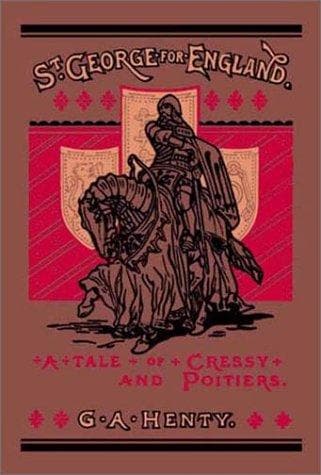
St. George for EnglandHenty, G. A. (George Alfred)
History
St. George for England
Henty, G. A. (George Alfred)
Great Britain -- History -- Edward III, 1327-1377 -- Fiction
When the army had taken up its position, the king, mounted on a
small palfrey, with a white staff in his hand, rode from rank to rank
exhorting his soldiers to do their duty gallantly. It was nearly noon
before he had passed through all the lines, and permission was
then given to the soldiers to fall out from their ranks and to take
refreshments while waiting for the coming of the enemy. This was
accordingly done, the men eating and drinking at their ease and lying
down in their ranks on the soft grass with their steel caps and their
bows or pikes beside them.
In the meantime the French had, on their side, been preparing for the
battle. Phillip had crossed the Somme at Abbeyville late on Thursday
afternoon, and remained there next day marshalling the large
reinforcements which were hourly arriving. His force now considerably
exceeded 100,000 men, the number with which he had marched from Amiens
three days previously.
Friday was the festival of St. Louis, and that evening Phillip gave a
splendid banquet to the whole of the nobles of his army.
On the following morning the king, accompanied by his brother the Count
d'Alencon, the old King of Bohemia and his son, the King of Rome, the
Duke of Lorraine, the Count of Blois, the Count of Flanders, and a
great number of other feudal princes, heard Mass at the Abbey, and then
marched with his great army towards Cressy. He moved but slowly in order
to give time to all the forces scattered over the neighbourhood to come
up, and four knights, headed by one of the King of Bohemia's officers,
went forward to reconnoitre the English position. They approached within
a very short distance of the English lines and gained a very exact
knowledge of the position, the English taking no measures to interrupt
the reconnaissance. They returned with the information they had
gathered, and the leader of the party, Le Moyne de Basele, one of the
most judicious officers of his time, strongly advised the king to halt
his troops, pointing out that as it was evident the English were ready
to give battle, and as they were fresh and vigorous while the French
were wearied and hungry, it would be better to encamp and give battle
the next morning.
Public-domain text, read in full here on John Shaqi.
Reviews
Reviews
No reviews yet
Be the first to share your thoughts on this work.
Elsewhere in the archive
Join the Discussion
Join the discussion
Sign in to leave a comment or review.
Sign InorCreate an account