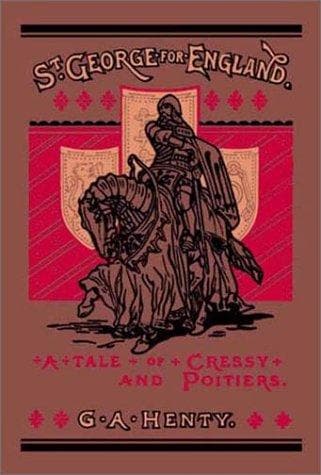
St. George for EnglandHenty, G. A. (George Alfred)
History
St. George for England
Henty, G. A. (George Alfred)
Great Britain -- History -- Edward III, 1327-1377 -- Fiction
Phillip saw the wisdom of the advice and ordered his two marshals the
Lord of St. Venant and Charles de Montmorency to command a halt. They
instantly spurred off, one to the front and the other to the rear,
commanding the leaders to halt their banners. Those in advance at once
obeyed, but those behind still pressed on, declaring that they would not
halt until they were in the front line. All wanted to be first, in order
to obtain their share of the honour and glory of defeating the English.
Those in front, seeing the others still coming on, again pressed
forward, and thus, in spite of the efforts of the king and his marshals,
the French nobles with their followers pressed forward in confusion,
until, passing through a small wood, they found themselves suddenly in
the presence of the English army.
CHAPTER XIV: CRESSY
The surprise of the French army at finding themselves in the presence
of the English was so great that the first line recoiled in confusion.
Those marching up from behind imagined that they had been already
engaged and repulsed by the English, and the disorder spread through the
whole army, and was increased by the common people, who had crowded to
the field in immense numbers from the whole country round to see the
battle and share in the plunder of the English camp.
From King Edward's position on the rising ground he could see the
confusion which prevailed in the French ranks, and small as were his
forces he would probably have obtained an easy victory by ordering a
sudden charge upon them. The English, however, being dismounted, but
small results would have followed the scattering of the great host of
the French. The English army therefore remained immovable, except that
the soldiers rose from the ground, and taking their places in the ranks,
awaited the onslaught of the enemy.
King Phillip himself now arrived on the field and his hatred for the
English led him at once to disregard the advice which had been given him
and to order the battle to commence as soon as possible.
The army was divided into four bodies, of which Phillip commanded one,
the Count D'Alencon the second, the King of Bohemia the third, and
the Count of Savoy the fourth. Besides these were a band of 15,000
mercenaries, Genoese crossbow-men, who were now ordered to pass between
the ranks of cavalry and to clear the ground of the English archers, who
were drawn up in the usual form in which they fought--namely, in very
open order, line behind line, the men standing alternately, so that each
had ample room to use his bow and to fire over the heads of those in
front. The formation was something like that of a harrow, and, indeed,
exactly resembled that in which the Roman archers fought, and was called
by them a quincunx.
Public-domain text, read in full here on John Shaqi.
Reviews
Reviews
No reviews yet
Be the first to share your thoughts on this work.
Elsewhere in the archive
Join the Discussion
Join the discussion
Sign in to leave a comment or review.
Sign InorCreate an account