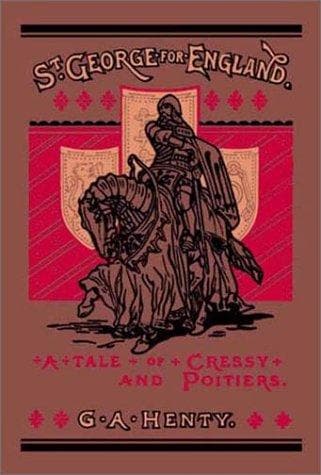
St. George for EnglandHenty, G. A. (George Alfred)
History
St. George for England
Henty, G. A. (George Alfred)
Great Britain -- History -- Edward III, 1327-1377 -- Fiction
The prince and those around him were filled with fresh ardour when
they received this message. Each man redoubled his efforts to repel the
forces that were incessantly poured down upon them by the French. On all
sides these pressed around them, striving desperately, but ever in vain,
to break through the solid ranks of the English. The French men-at-arms
suffered, moreover, terribly from the attacks of the Welsh infantry.
These men, clad in thick leather jerkins, nimble of foot, accustomed to
a life of activity, were armed with shortened lances and knives, mingled
fearlessly among the confused mass of French cavalry, creeping beneath
the horses' bellies, standing up when they got a chance, and stabbing
horses and men with their knives and pikes. Many were trampled upon or
struck down, but numbering, as they did, 6000, they pervaded the whole
mass of the enemy, and did terrible execution, adding in no small degree
to the confusion caused by the shower of arrows from the archers within
the circle of the men-at-arms. The instant a French knight fell, struck
from his horse with a battle-axe or arrow, or by the fall of a wounded
steed, the half-wild Welsh were upon him, and slew him before he could
regain his feet.
The slaughter was immense. The Count of Harcourt, with his nephew the
Count D'Aumale and his two gallant sons, fell together, and at last
Charles of Luxembourg, seeing his banner down, his troops routed, his
friends slain, and the day irreparably lost, and being himself severely
wounded in three places, turned his horse and fled, casting off his
rich emblazoned surcoat to avoid recognition. In the meantime Prince
Charles's father, the veteran King of Bohemia, once one of the most
famous warriors of Europe, but now old and blind, sat on horseback at
a little distance from the fight; the knights around him told him the
events as they happened, and the old monarch soon saw that the day was
lost. He asked them for tidings of his son Charles of Luxembourg, but
they were forced to reply that the banner of the King of the Romans was
no longer in sight, but that, doubtless, he was somewhere engaged in the
melee.
“Lords,” said the old man, “you are my vassals, my friends, and my
companions, and on this day I command and beseech you to lead me forward
so far that I may deal one blow of my sword in the battle.”
His faithful friends obeyed him, a number of knights arranged themselves
around him, and lest they should lose him in the fight they tied their
horses together by the bridles and charged down into the fray. Advancing
directly against the banner of the Prince of Wales, the blind monarch
was carried into the midst of the thickest strife.
There the little group of knights fought gallantly, and after the
battle was over, the bodies of the king and his friends were found lying
together, their dead horses still linked by the bridles.
Public-domain text, read in full here on John Shaqi.
Reviews
Reviews
No reviews yet
Be the first to share your thoughts on this work.
Elsewhere in the archive
Join the Discussion
Join the discussion
Sign in to leave a comment or review.
Sign InorCreate an account