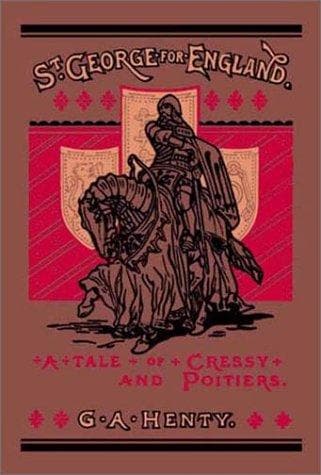
St. George for EnglandHenty, G. A. (George Alfred)
History
St. George for England
Henty, G. A. (George Alfred)
Great Britain -- History -- Edward III, 1327-1377 -- Fiction
During this terrible battle, which had been raging since three o'clock,
Phillip had made strenuous efforts to aid his troops engaged in the
front by continually sending fresh bodies to the assault. It was now
growing dark, terror and confusion had already spread among the French,
and many were flying in all directions, and the unremitting showers of
English arrows still flew like hail among their ranks. As the king made
his way forward, surrounded by his personal attendants to take part
himself in the fight, his followers fell thick around him, and his horse
was slain by an arrow. John of Hainault, who had remained by his side
during the whole day, mounted upon a fresh horse and urged him to fly,
as the day was lost. Phillip, however, persisted, and made his way into
the melee, where he fought for some time with extreme courage, until
almost all around him were slain, the royal standard bearer killed, and
himself wounded in two places. John of Hainault then seized his bridle
exclaiming “Come away, sire, it is full time; do not throw your life
away foolishly; if you have lost this day you will win another,” and so
almost forced the unwilling king from the field. Phillip, accompanied by
the lords of Montmorency, Beaujeu, Aubigny, and Mansault, with John of
Hainault, and sixty men-at-arms, rode to the Castle of Broye, and there
halted for a few hours. At midnight he again set out, and in the morning
arrived safely at Amiens.
The Black Prince held his station until night without yielding a
single step to all the efforts of the French. Gradually, however, the
assailants became less and less numerous, the banners disappeared,
and the shouts of the leaders and the clang of arms died away, and
the silence which prevailed over the field at once announced that the
victory was complete and the enemy in full flight. An immense number
of torches were now lighted through the English lines, and the king,
quitting for the first time his station on the hill, came down to
embrace his gallant son. Edward and his host rejoiced in a spirit
of humility over the victory. No songs of triumph, no feastings or
merriment were permitted, but a solemn service of the church was held,
and the king and his soldiers offered their thanks to God for the
victory He had given them. The English army lay all night under arms,
and a number of scattered parties of the French, wandering about in the
darkness, entered the lines and were slain or taken prisoners.
The dawn of the next morning was thick and foggy, and intelligence
coming in that a large body of the enemy were advancing upon them, the
Earls of Northampton, Warwick, and Norfolk, with 500 men-at-arms and
2000 archers, went out to reconnoitre, and came in the misty twilight
upon an immense force composed of the citizens of Beauvais, Rouen, and
some other towns, led by the Grand Prior of France and the Archbishop of
Rouen, who were approaching the field.
Public-domain text, read in full here on John Shaqi.
Reviews
Reviews
No reviews yet
Be the first to share your thoughts on this work.
Elsewhere in the archive
Join the Discussion
Join the discussion
Sign in to leave a comment or review.
Sign InorCreate an account