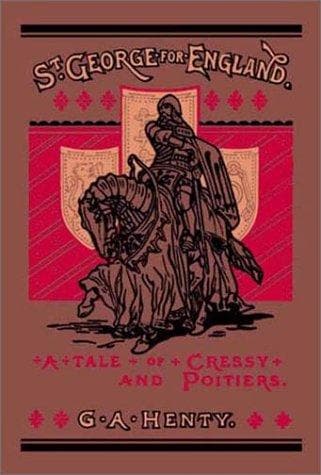
St. George for EnglandHenty, G. A. (George Alfred)
History
St. George for England
Henty, G. A. (George Alfred)
Great Britain -- History -- Edward III, 1327-1377 -- Fiction
Proclamations were issued in England and Flanders inviting traders to
establish stores and to bring articles of trade of all kinds, and in a
short time a complete town sprang up which was named by Edward “New-Town
the Bold”. The English fleet held complete possession of the sea,
cutting off the besieged from all succour by ship, and enabling abundant
supplies for the army to be brought from England and Flanders. Strong
parties were sent out in all directions. The northern provinces of
France were scoured, and the army was amply provided with necessaries
and even luxuries.
After the first terrible shock caused by the crushing defeat of Cressy,
King Phillip began at once to take measures for the relief of Calais,
and made immense efforts again to put a great army in the field. He
endeavoured by all means in his power to gain fresh allies. The young
Count of Flanders, who, at the death of his father at Cressy, was
sixteen years of age, was naturally even more hostile to the English
than the late prince had been, and he strove to win over his subjects to
the French alliance, while Phillip made them magnificent offers if they
would join him. The Flemings, however, remained stanch to the English
alliance, and held their prince in duresse until he at last consented
to marry the daughter of Edward. A week before the date fixed for the
nuptials, however, he managed to escape from the vigilance of his guards
when out hawking, and fled to the court of France.
In Scotland Phillip was more successful, and David Bruce, instead of
employing the time given him by the absence of Edward with his armies in
driving out the English garrisons from the strong places they still held
in Scotland, raised an army of 50,000 men and marched across the border
into England plundering and ravaging. Queen Philippa, however, raising
an army, marched against him, and the Scotch were completely defeated
at Neville's Cross, 15,000 being killed and their king himself taken
prisoner.
Walter's conduct at the battle of Cressy gained him still further the
favour of the Black Prince. The valour with which he had fought was
conspicuous even on a field where all fought gallantly, and the prince
felt that more than once he would have been smitten down had not
Walter's sword interposed. Ralph too had fought with reckless bravery,
and many French knights and gentlemen had gone down before the
tremendous blows of his heavy mace, against which the stoutest armour
availed nothing. After the battle the prince offered to make him an
esquire in spite of the absence of gentle blood in his veins, but Ralph
declined the honour.
Public-domain text, read in full here on John Shaqi.
Reviews
Reviews
No reviews yet
Be the first to share your thoughts on this work.
Elsewhere in the archive
Join the Discussion
Join the discussion
Sign in to leave a comment or review.
Sign InorCreate an account