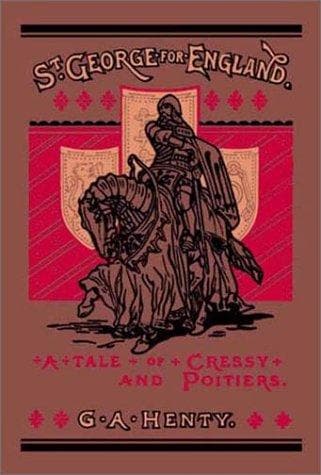
St. George for EnglandHenty, G. A. (George Alfred)
History
St. George for England
Henty, G. A. (George Alfred)
Great Britain -- History -- Edward III, 1327-1377 -- Fiction
By some extraordinary accident they had not met any of the fugitives
flying from Cressy, and were ignorant that a battle had been fought.
The English charged them at once. Their advance-guard, consisting of
burghers, was easily overthrown. The second division, which was composed
of men-at-arms, fought bravely, but was unable to withstand the charge
of the triumphant English, and was completely broken and defeated.
The Grand Prior was killed and a vast number of his followers slain or
captured. During the whole of the morning detached parties from Edward's
army scoured the country, dispersing and slaughtering bands of French
who still remained together, and towards night the Earl of Northampton
returned to the camp with the news that no enemy remained in the
vicinity that could offer a show of resistance to the English force.
It is said that a far greater number of French were killed upon the
second day than upon the first. This can be accounted for by the fact
that on the first day but a small portion of the English army were
engaged, and that upon the second the English were fresh and vigorous,
and their enemy exhausted and dispirited.
The greater number of the French nobles and knights who fell, died in
their attempts to break through the Black Prince's array. Besides the
King of Bohemia, nine sovereign princes and eighty great nobles were
killed, with 1200 knights, 1500 men-at-arms, and 30,000 foot; while on
the English side only three knights and a small number of men-at-arms
and infantry were killed.
The body of the King of Bohemia and those of the other great leaders
were carried in solemn pomp to the Abbey of Maintenay. Edward himself
and his son accompanied them as mourners. On the Monday following
Edward marched with his army against Calais, and summoned the town to
surrender. John of Vienne, who commanded the garrison, refused to comply
with the demand. The fortifications of the town were extremely strong
and the garrison numerous, and Edward perceived that an assault would be
very unlikely to succeed, and would entail great loss, while a repulse
would have dimmed the lustre of the success which he had gained. He
therefore determined to reduce it by famine, and the troops were set to
work to build huts. So permanently and strongly were these constructed
that it seemed to the enemy that King Edward was determined to remain
before Calais even should he have to stay there for ten years.
Public-domain text, read in full here on John Shaqi.
Reviews
Reviews
No reviews yet
Be the first to share your thoughts on this work.
Elsewhere in the archive
Join the Discussion
Join the discussion
Sign in to leave a comment or review.
Sign InorCreate an account