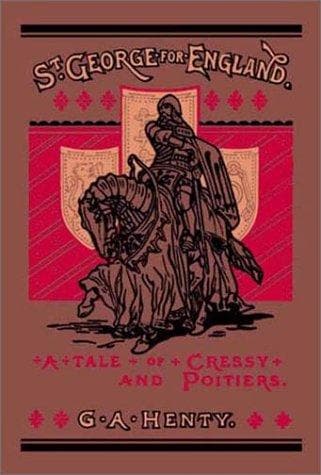
St. George for EnglandHenty, G. A. (George Alfred)
History
St. George for England
Henty, G. A. (George Alfred)
Great Britain -- History -- Edward III, 1327-1377 -- Fiction
For some hours the fight was continued with unabating obstinacy on both
sides. The king and the Black Prince fought with immense bravery, their
example encouraging even those of their soldiers who were ignorant
of the personality of the knights who were everywhere in front of the
combat. King Edward himself several times crossed swords with the famous
Eustace de Ribaumont, one of the most gallant knights in France. At
length towards daybreak the king, with only thirty companions, found
himself again opposed to De Ribaumont with a greatly superior force, and
the struggle was renewed between them.
Twice the king was beaten down on one knee by the thundering blows
of the French knight, twice he rose and renewed the attack, until De
Charny, seeing Sir Walter Manny's banner, beside which Edward fought,
defended by so small a force, also bore down to the attack, and in the
struggle Edward was separated from his opponent.
The combat now became desperate round the king, and Sir Guy Brian, who
bore De Manny's standard, though one of the strongest and most gallant
knights of the day, could scarce keep the banner erect. Still Edward
fought on, and in the excitement of the moment, forgetting his
incognito, he accompanied each blow with his customary war-cry--“Edward,
St. George! Edward, St. George!” At that battle-cry, which told the
French men-at-arms that the King of England was himself opposed to them,
they recoiled for a moment. The shout too reached the ears of the Prince
of Wales, who had been fighting with another group. Calling his knights
around him he fell upon the rear of De Charny's party and quickly
cleared a space around the king.
The fight was now everywhere going against the French, and the English
redoubling their efforts the victory was soon complete, and scarcely
one French knight left the ground alive and free. In the struggle Edward
again encountered De Ribaumont, who, separated from him by the charge of
De Charny, had not heard the king's war-cry. The conflict between them
was a short one. The French knight saw that almost all his companions
were dead or captured, his party completely defeated, and all prospects
of escape cut off. He therefore soon dropped the point of his sword and
surrendered to his unknown adversary. In the meantime the troops which
had been despatched to the bridge of Nieullay had defeated the French
forces left to guard the passage and clear the ground towards St. Omer.
Public-domain text, read in full here on John Shaqi.
Reviews
Reviews
No reviews yet
Be the first to share your thoughts on this work.
Elsewhere in the archive
Join the Discussion
Join the discussion
Sign in to leave a comment or review.
Sign InorCreate an account