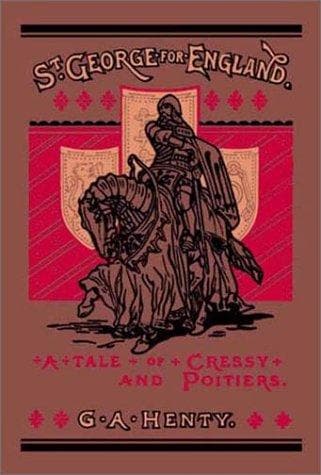
St. George for EnglandHenty, G. A. (George Alfred)
History
St. George for England
Henty, G. A. (George Alfred)
Great Britain -- History -- Edward III, 1327-1377 -- Fiction
Early in the morning Edward entered Calais in triumph, taking with him
thirty French nobles as prisoners, while two hundred more remained dead
on the field. That evening a great banquet was held, at which the French
prisoners were present. The king presided at the banquet, and the French
nobles were waited upon by the Black Prince and his knights. After the
feast was concluded the king bestowed on De Ribaumont the chaplet of
pearls which he wore round his crown, hailing him as the most gallant of
the knights who had that day fought, and granting him freedom to return
at once to his friends, presenting him with two horses, and a purse to
defray his expenses to the nearest French town.
De Charny was afterwards ransomed, and after his return to France
assembled a body of troops and attacked the castle which Edward had
bestowed upon Almeric of Pavia, and capturing the Lombard, carried him
to St. Omer, and had him there publicly flayed alive as a punishment for
his treachery.
Walter had as usual fought by the side of the Prince of Wales throughout
the battle of Calais and had much distinguished himself for his valour.
Ralph was severely wounded in the fight, but was able a month later to
rejoin Walter in England.
The battle of Calais and the chivalrous bearing of the king created
great enthusiasm and delight in England, and did much to rouse the
people from the state of grief into which they had been cast by the
ravages of the plague. The king did his utmost to maintain the spirit
which had been evoked, and the foundation of the order of the Garter,
and the erection of a splendid chapel at Windsor, and its dedication,
with great ceremony, to St. George, the patron saint of England, still
further raised the renown of the court of Edward throughout Europe as
the centre of the chivalry of the age.
Notwithstanding many treaties which had taken place, and the near
alliance which had been well-nigh carried out between the royal families
of England and Spain, Spanish pirates had never ceased to carry on a
series of aggressions upon the English vessels trading in the Bay of
Biscay. Ships were every day taken, and the crews cruelly butchered
in cold blood. Edward's remonstrances proved vain, and when threats of
retaliation were held out by Edward, followed by preparations to carry
those threats into effect, Pedro the Cruel, who had now succeeded to the
throne of Spain, despatched strong reinforcements to the fleet which had
already swept the English Channel.
The great Spanish fleet sailed north, and capturing on its way a number
of English merchantmen, put into Sluys, and prepared to sail back
in triumph with the prizes and merchandise it had captured. Knowing,
however, that Edward was preparing to oppose them, the Spaniards filled
up their complement of men, strengthened themselves by all sorts of the
war machines then in use, and started on their return for Spain with one
of the most powerful armadas that had ever put to sea.
Public-domain text, read in full here on John Shaqi.
Reviews
Reviews
No reviews yet
Be the first to share your thoughts on this work.
Elsewhere in the archive
Join the Discussion
Join the discussion
Sign in to leave a comment or review.
Sign InorCreate an account