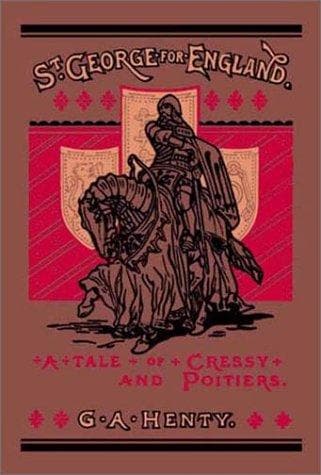
St. George for EnglandHenty, G. A. (George Alfred)
History
St. George for England
Henty, G. A. (George Alfred)
Great Britain -- History -- Edward III, 1327-1377 -- Fiction
The position appeared well-nigh desperate, but the prince and his most
experienced knights at once reconnoitered the country to choose the best
ground upon which to do battle. An excellent position was chosen. It
consisted of rising ground commanding the country towards Poitiers, and
naturally defended by the hedges of a vineyard. It was only accessible
from Poitiers by a sunken road flanked by banks and fences, and but wide
enough to admit of four horsemen riding abreast along it. The ground on
either side of this hollow way was rough and broken so as to impede the
movements even of infantry, and to render the maneuvers of a large
body of cavalry nearly impracticable. On the left of the position was a
little hamlet called Maupertuis. Here on the night of Saturday the
17th of September the prince encamped, and early next morning made his
dispositions for the battle. His whole force was dismounted and occupied
the high ground, a strong body of archers lined the hedges on either
side of the sunken road; the main body of archers were drawn up in their
usual formation on the hillside, their front covered by the hedge of the
vineyard, while behind them the men-at-arms were drawn up.
The King of France divided his army into three divisions, each
consisting of 16,000 mounted men-at-arms besides infantry, commanded
respectively by the Duke of Orleans, the king's brother, the dauphin,
and the king himself. With the two royal princes were the most
experienced of the French commanders. In the meantime De Ribaumont, with
three other French knights, reconnoitered the English position, and on
their return with their report strongly advised that as large bodies of
cavalry would be quite useless owing to the nature of the ground, the
whole force should dismount except 300 picked men designed to break the
line of English archers and a small body of German horse to act as a
reserve.
Just as the King of France was about to give orders for the advance, the
Cardinal of Perigord arrived in his camp, anxious to stop, if possible,
the effusion of blood. He hurried to the King of France.
“You have here, sire,” he said, “the flower of all the chivalry of your
realm assembled against a mere handful of English, and it will be
far more honourable and profitable for you to have them in your power
without battle than to risk such a noble array in uncertain strife. I
pray you, then, in the name of God, to let me ride on to the Prince of
Wales, to show him his peril, and to exhort him to peace.”
“Willingly, my lord,” the king replied; “but above all things be quick.”
Public-domain text, read in full here on John Shaqi.
Reviews
Reviews
No reviews yet
Be the first to share your thoughts on this work.
Elsewhere in the archive
Join the Discussion
Join the discussion
Sign in to leave a comment or review.
Sign InorCreate an account