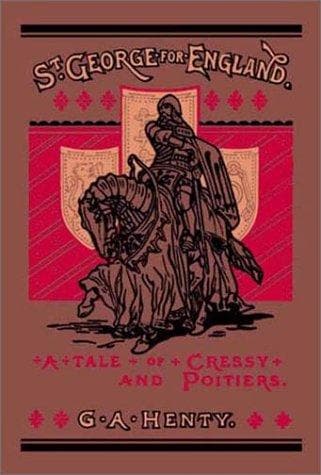
St. George for EnglandHenty, G. A. (George Alfred)
History
St. George for England
Henty, G. A. (George Alfred)
Great Britain -- History -- Edward III, 1327-1377 -- Fiction
The cardinal at once hastened to the English camp; he found the Black
Prince in the midst of his knights ready for battle, but by no means
unwilling to listen to proposals for peace. His position was indeed
most perilous. In his face was an enormously superior army, and he was
moreover threatened by famine; even during the two preceding days his
army had suffered from a great scarcity of forage, and its provisions
were almost wholly exhausted. The French force was sufficiently numerous
to blockade him in his camp, and he knew that did they adopt that course
he must surrender unconditionally, since were he forced to sally out and
attack the French no valour could compensate for the immense disparity
of numbers. He therefore replied at once to the cardinal's application,
that he was ready to listen to any terms by which his honour and that of
his companions would be preserved.
The cardinal returned to the King of France and with much entreaty
succeeded in obtaining a truce until sunrise on the following morning.
The soldiers returned to their tents, and the cardinal rode backward and
forward between the armies, beseeching the King of France to moderate
his demands, and the Black Prince to submit to the evil fortune which
had befallen him; but on the one side the king looked upon the victory
as certain, and on the other the Black Prince thought that there was at
least a hope of success should the French attack him. All, therefore,
that the cardinal could obtain from him was an offer to resign all he
had captured in his expedition, towns, castles, and prisoners, and
to take an oath not to bear arms against France for seven years. This
proposal fell so far short of the demands of the French king that
pacification soon appeared hopeless.
Early on the Monday morning the cardinal once more sought the presence
of the French king, but found John inflexible; while some of the leaders
who had viewed with the strongest disapproval his efforts to snatch what
they regarded as certain victory from their hands, gave him a peremptory
warning not to show himself again in their lines. The prelate then bore
the news of his failure to the Prince of Wales. “Fair son,” he said, “do
the best you can, for you must needs fight, as I can find no means of
peace or amnesty with the King of France.”
“Be it so, good father,” the prince replied, “it is our full resolve to
fight, and God will aid the right.”
The delay which had occurred had not been without advantages for the
British army, although the shortness of provisions was greatly felt.
Every effort had been made to strengthen the position. Deep trenches
had been dug and palisades erected around it, and the carts and baggage
train had all been moved round so as to form a protection on the weakest
side of the camp, where also a rampart had been constructed.
Public-domain text, read in full here on John Shaqi.
Reviews
Reviews
No reviews yet
Be the first to share your thoughts on this work.
Elsewhere in the archive
Join the Discussion
Join the discussion
Sign in to leave a comment or review.
Sign InorCreate an account