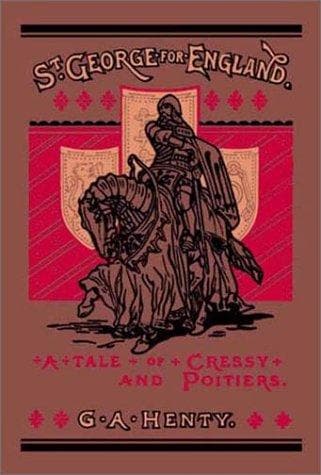
St. George for EnglandHenty, G. A. (George Alfred)
History
St. George for England
Henty, G. A. (George Alfred)
Great Britain -- History -- Edward III, 1327-1377 -- Fiction
Upon a careful examination of the ground it was found that the hill on
the right side of the camp was less difficult than had been supposed,
and that the dismounted men-at-arms who lay at its foot under the
command of the Dauphin would find little difficulty in climbing it to
the assault. The prince therefore gave orders that 300 men-at-arms and
300 mounted archers should make a circuit from the rear round the
base of the hill, in order to pour in upon the flank of the Dauphin's
division as soon as they became disordered in the ascent. The nature
of the ground concealed this maneuver from the enemies' view, and the
Captal De Buch, who was in command of the party, gained unperceived the
cover of a wooded ravine within a few hundred yards of the left flank
of the enemy. By the time that all these dispositions were complete the
huge French array was moving forward. The Black Prince, surrounded by
his knights, viewed them approaching.
“Fair lords,” he said, “though we be so few against that mighty power
of enemies, let us not be dismayed, for strength and victory lie not in
multitudes, but in those to whom God give them. If He will the day be
ours, then the highest glory of this world will be given to us. If we
die, I have the noble lord, my father, and two fair brothers, and you
have each of you many a good friend who will avenge us well; thus, then,
I pray you fight well this day, and if it please God and St. George I
will also do the part of a good knight.”
The prince then chose Sir John Chandos and Sir James Audley to remain by
his side during the conflict in order to afford him counsel in case of
need. Audley, however, pleaded a vow which he had made long before, to
be the first in battle should he ever be engaged under the command of
the King of England or any of his children. The prince at once
acceded to his request to be allowed to fight in the van, and Audley,
accompanied by four chosen squires, took his place in front of the
English line of battle. Not far from him, also in advance of the line,
was Sir Eustace D'Arnbrecicourt on horseback, also eager to distinguish
himself.
As Sir James rode off the prince turned to Walter. “As Audley must needs
fight as a knight-errant, Sir Walter Somers, do you take your place by
my side, for there is no more valiant knight in my army than you have
often proved yourself to be.”
Three hundred chosen French men-at-arms mounted on the strongest
horses covered with steel armour, led the way under the command of the
Marechals D'Audeham and De Clermont; while behind them were a large body
of German cavalry under the Counts of Nassau, Saarbruck, and Nidau, to
support them in their attack on the English archers. On the right was
the Duke of Orleans with 16,000 men-at-arms; on the left the Dauphin and
his two brothers with an equal force; while King John himself led on the
rear-guard.
Public-domain text, read in full here on John Shaqi.
Reviews
Reviews
No reviews yet
Be the first to share your thoughts on this work.
Elsewhere in the archive
Join the Discussion
Join the discussion
Sign in to leave a comment or review.
Sign InorCreate an account