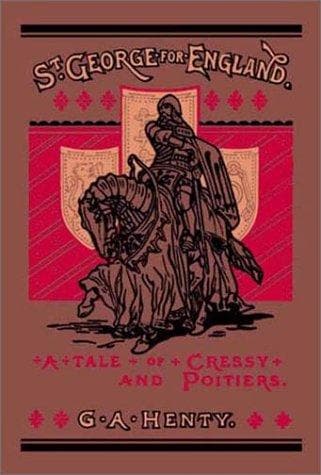
St. George for EnglandHenty, G. A. (George Alfred)
History
St. George for England
Henty, G. A. (George Alfred)
Great Britain -- History -- Edward III, 1327-1377 -- Fiction
Not long after they reached that city the Cardinal of Perigord and
another legate presented themselves to arrange peace, and these
negotiations went on throughout the winter. The prince had received full
powers from his father, and his demands were very moderate; but in
spite of this no final peace could be arranged, and the result of the
conference was the proclamation of a truce, to last for two years from
the following Easter. During the winter immense numbers of the prisoners
who had gone at large upon parole, came in and paid their ransoms, as
did the higher nobles who had been taken prisoners, and the whole army
was greatly enriched. At the end of April the prince returned to England
with King John. The procession through the streets of London was a
magnificent one, the citizens vying with each other in decorating their
houses in honour of the victor of Poitiers, who, simply dressed, rode
on a small black horse by the side of his prisoner, who was splendidly
attired, and mounted on a superb white charger. The king received his
royal prisoner in state in the great hall of his palace at Westminster,
and did all in his power to alleviate the sorrows of his condition. The
splendid palace of the Savoy, with gardens extending to the Thames, was
appointed for his residence, and every means was taken to soften his
captivity.
During the absence of the Black Prince in Guienne the king had been
warring in Scotland. Here his success had been small, as the Scotch had
retreated before him, wasting the country. David Bruce, the rightful
king, was a prisoner in England, and Baliol, a descendant of the rival
of Robert Bruce, had been placed upon the throne. As Edward passed
through Roxburgh he received from Baliol a formal cession of his rights
and titles to the throne of Scotland, and in return for this purely
nominal gift he bestowed an annual income upon Baliol, who lived
and died a pensioner of England. After Edward's return to England
negotiations were carried on with the Scots, and a treaty was signed by
which a truce for ten years was established between the two countries,
and the liberation of Bruce was granted on a ransom of 100,000 marks.
Public-domain text, read in full here on John Shaqi.
Reviews
Reviews
No reviews yet
Be the first to share your thoughts on this work.
Elsewhere in the archive
Join the Discussion
Join the discussion
Sign in to leave a comment or review.
Sign InorCreate an account