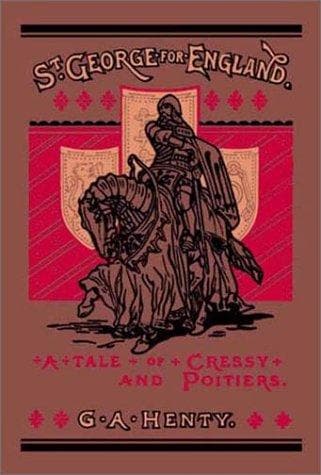
St. George for EnglandHenty, G. A. (George Alfred)
History
St. George for England
Henty, G. A. (George Alfred)
Great Britain -- History -- Edward III, 1327-1377 -- Fiction
The attack on the market-house continued, and the Duke of Orleans held
a consultation with the three knights. It was agreed that against such
a host of enemies the market-place could not long be defended, and that
their best hope lay in sallying out and falling upon the assailants.
Accordingly the men-at-arms were drawn up in order, with the banners of
the Duke of Orleans and the Count de Foix, and the pennons of the
Captal and Sir Walter Somers displayed, the gates were opened, and with
levelled lances the little party rode out. Hitherto nothing had been
heard save yells of anticipated triumph and fierce imprecations and
threats against the defenders from the immense multitude without; but
the appearance of the orderly ranks of the knights and men-at-arms as
they issued through the gate struck a silence of fear through the mass.
Without an instant's delay the knights and men-at-arms, with levelled
lances, charged into the multitude. A few attempted to fight, but more
strove to fly, as the nobles and their followers, throwing away their
lances, fell upon them with sword and battle-axe. Jammed up in the
narrow streets of a small walled town, overthrowing and impeding each
other in their efforts to escape, trampled down by the heavy horses
of the men-at-arms, and hewn down by their swords and battle-axes,
the insurgents fell in vast numbers. Multitudes succeeded in escaping
through the gates into the fields; but here they were followed by the
knights and their retainers, who continued charging among them and
slaying till utter weariness compelled them to cease from the pursuit
and return to Meaux. Not less than seven thousand of the insurgents
had been slain by the four knights and fifty men, for ten had been left
behind to guard the gates of the market-place.
History has no record of so vast a slaughter by so small a body of men.
This terrific punishment put a summary end to the Jacquerie. Already
in other parts several bodies had been defeated, and their principal
leader, Caillet, with three thousand of his followers, slain near
Clermont. But the defeat at Meaux was the crushing blow which put an end
to the insurrection.
On their return to the town the knights executed a number of the
burghers who had joined the peasants, and the greater part of the town
was burned to the ground as a punishment for having opened the gates to
the peasants and united with them.
Public-domain text, read in full here on John Shaqi.
Reviews
Reviews
No reviews yet
Be the first to share your thoughts on this work.
Elsewhere in the archive
Join the Discussion
Join the discussion
Sign in to leave a comment or review.
Sign InorCreate an account