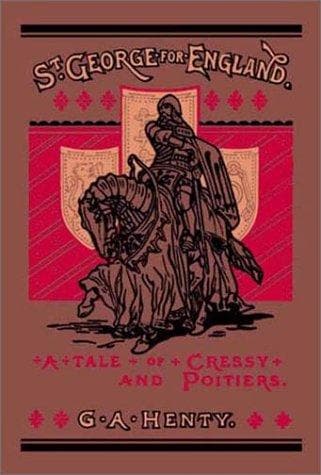
St. George for EnglandHenty, G. A. (George Alfred)
History
St. George for England
Henty, G. A. (George Alfred)
Great Britain -- History -- Edward III, 1327-1377 -- Fiction
The knights and ladies then started for Paris. On nearing the city they
found that it was threatened by the forces of the Dauphin. Marcel had
strongly fortified the town, and with his ally, the infamous King of
Navarre, bade defiance to the royal power. However, the excesses of the
demagogue had aroused against him the feeling of all the better class
of the inhabitants. The King of Navarre, who was ready at all times to
break his oath and betray his companions, marched his army out of
the town and took up a position outside the walls. He then secretly
negotiated peace with the Duke of Normandy, by which he agreed to yield
to their fate Marcel and twelve of the most obnoxious burghers, while
at the same time he persuaded Marcel that he was still attached to
his interest. Marcel, however, was able to bid higher than the Duke of
Normandy, and he entered into a new treaty with the treacherous king, by
which he stipulated to deliver the city into his hands during the night.
Everyone within the walls, except the partisans of Marcel, upon whose
doors a mark was to be placed, were to be put to death indiscriminately,
and the King of Navarre was to be proclaimed King of France.
Fortunately Pepin des Essarts and John de Charny, two loyal knights who
were in Paris, obtained information of the plan a few minutes before
the time appointed for its execution. Arming themselves instantly,
and collecting a few followers, they rushed to the houses of the chief
conspirators, but found them empty, Marcel and his companions having
already gone to the gates. Passing by the hotel-de-ville, the knights
entered, snatched down the royal banner which was kept there, and
unfurling it mounted their horses and rode through the streets, calling
all men to arms. They reached the Port St. Antoine just at the moment
when Marcel was in the act of opening it in order to give admission to
the Navarrese. When he heard the shouts he tried with his friends to
make his way into the bastille, but his retreat was intercepted, and a
severe and bloody struggle took place between the two parties. Stephen
Marcel, however, was himself slain by Sir John de Charny, and almost all
his principal companions fell with him. The inhabitants then threw open
their gates and the Duke of Normandy entered.
Walter Somers had, with his companions, joined the army of the duke,
and placed his sword at his disposal; but when the French prince entered
Paris without the necessity of fighting, he took leave of him, and with
the Captal returned to England. Rare, indeed, were the jewels which
Walter brought home to his wife, for the three hundred noble ladies
rescued at Meaux from dishonour and death had insisted upon bestowing
tokens of their regard and gratitude upon the rescuers, and as many of
them belonged to the richest as well as the noblest families in France
the presents which Walter thus received from the grateful ladies were of
immense value.
Public-domain text, read in full here on John Shaqi.
Reviews
Reviews
No reviews yet
Be the first to share your thoughts on this work.
Elsewhere in the archive
Join the Discussion
Join the discussion
Sign in to leave a comment or review.
Sign InorCreate an account