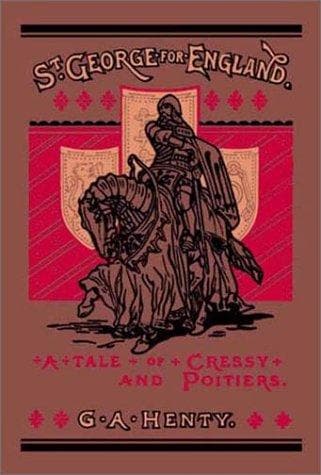
St. George for EnglandHenty, G. A. (George Alfred)
History
St. George for England
Henty, G. A. (George Alfred)
Great Britain -- History -- Edward III, 1327-1377 -- Fiction
At the conclusion of the two years' truce Edward, with the most
splendidly-equipped army which had ever left England, marched through
the length and breadth of France. Nowhere did he meet with any
resistance in the field. He marched under the walls of Paris, but took
no steps to lay siege to that city, which would have fallen an easy
prey to his army had he chosen to capture it. That he did not do so is
another proof that he had no desire to add France to the possessions of
the English crown. At length, by the efforts of the pope, a peace was
agreed upon, by which France yielded all Aquitaine and the town of
Calais to England as an absolute possession, and not as a fief of the
crown of France; while the English king surrendered all his captures in
Normandy and Brittany and abandoned his claim to the crown of France.
With great efforts the French raised a portion of the ransom demanded
for the king, and John returned to France after four years of captivity.
At the commencement of 1363 Edward the Black Prince was named Prince
of Aquitaine, and that province was bestowed upon him as a gift by the
king, subject only to liege homage and an annual tribute of one ounce
of gold. The prince took with him to his new possessions many of the
knights and nobles who had served with him, and offered to Walter a high
post in the government of the province if he would accompany him. This
Walter begged to be excused from doing. Two girls had now been added
to his family, and he was unwilling to leave his happy home unless the
needs of war called him to the prince's side. He therefore remained
quietly at home.
When King John returned to France, four of the French princes of the
blood-royal had been given as hostages for the fulfilment of the treaty
of Bretigny. They were permitted to reside at Calais, and were at
liberty to move about as they would, and even to absent themselves from
the town for three days at a time whensoever they might choose. The Duke
of Anjou, the king's second son, basely took advantage of this liberty
to escape, in direct violation of his oath. The other hostages followed
his example.
Public-domain text, read in full here on John Shaqi.
Reviews
Reviews
No reviews yet
Be the first to share your thoughts on this work.
Elsewhere in the archive
Join the Discussion
Join the discussion
Sign in to leave a comment or review.
Sign InorCreate an account