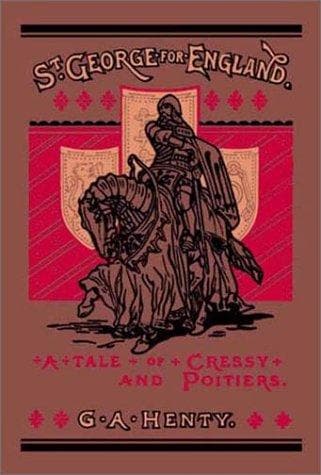
St. George for EnglandHenty, G. A. (George Alfred)
History
St. George for England
Henty, G. A. (George Alfred)
Great Britain -- History -- Edward III, 1327-1377 -- Fiction
King John, himself the soul of honour, was intensely mortified at this
breach of faith on the part of his sons, and after calling together the
states-general at Amiens to obtain the subsidies necessary for paying
the remaining portion of his ransom, he himself, with a train of two
hundred officers and their followers, crossed to England to make excuses
to Edward for the treachery of the princes. Some historians represent
the visit as a voluntary returning into captivity; but this was not
so. The English king had accepted the hostages in his place, and was
responsible for their safe-keeping, and had no claim upon the French
monarch because they had taken advantage of the excess of confidence
with which they had been treated. That the coming of the French king was
not in any way regarded as a return into captivity is shown by the
fact that he was before starting furnished by Edward with letters of
safe-conduct, by which his secure and unobstructed return to his own
country was expressly stipulated, and he was received by Edward as an
honoured guest and friend, and his coming was regarded as an honour and
an occasion for festivity by all England.
At the same time that John was in London the King of Cyprus, the King
of Denmark, and the King of Scotland were also there, and the meeting
of four monarchs in London was the occasion of extraordinary festivities
and rejoicing, the king and his royal guests being several times
entertained at sumptuous banquets by the lord-mayor, the ex-mayor Henry
Pickard, and several of the aldermen.
Six weeks after John's arrival in London he was seized with illness
at the palace of the Savoy, and died on the 8th of April, 1364. The
Dauphin, Charles, now succeeded him as Charles V, and the war between
the houses of Navarre and Valois was carried on with greater fury than
ever. The armies of Navarre were commanded by the Captal de Buch, who
was a distant relation of the king; while those of Charles were headed
by the Marechal de Boucicault and Bertrand du Guesclin, one of the most
gallant of the French knights. A great battle was fought near Cocherel.
Contrary to the orders of the Captal, his army, which consisted
principally of adventurers, descended from the strong position he had
chosen, and gave battle in the plain. They were completely defeated, and
the Captal himself taken prisoner.
In Brittany John of Montford and Charles of Blois had renewed their
struggle, and King Charles, seeing the danger of Brittany falling into
the hands of De Montford, who was a close ally of England, interfered in
favour of Charles of Blois, and sent Du Guesclin to his assistance.
Public-domain text, read in full here on John Shaqi.
Reviews
Reviews
No reviews yet
Be the first to share your thoughts on this work.
Elsewhere in the archive
Join the Discussion
Join the discussion
Sign in to leave a comment or review.
Sign InorCreate an account