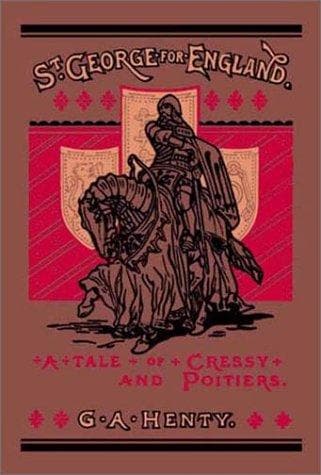
St. George for EnglandHenty, G. A. (George Alfred)
History
St. George for England
Henty, G. A. (George Alfred)
Great Britain -- History -- Edward III, 1327-1377 -- Fiction
Chandos then returned to De Montford, who had gallantly followed up the
advantage gained by the confusion into which Charles's division had been
thrown by the attack of Calverley. Charles was routed; he himself struck
down and slain by an English soldier, and the division defeated with
great slaughter. De Montford's whole force now gathered round Du
Guesclin's division, which now alone remained, and after fighting
gallantly until all hope was gone, the brave French knight and his
companions yielded themselves as prisoners.
The battle of Auray terminated the struggle between the houses of Blois
and Montford. More than 1000 French men-at-arms died on the field, among
whom were many of the noblest in Brittany. Two counts, 27 lords, and
1500 men-at-arms were made prisoners. De Montford now took possession of
the whole of Brittany, and at the suggestion of King Edward himself
did homage to Charles V for the duchy, which he afterwards ruled with
wisdom.
CHAPTER XXII: VICTORY AND DEATH
While the Black Prince was with difficulty governing his province
of Aquitaine, where the mutual jealousies of the English and native
officers caused continual difficulties, King Edward turned all his
attention to advancing the prosperity of England. He fostered trade,
commerce, and learning, was a munificent patron of the two universities,
and established such order and regularity in his kingdom that England
was the admiration of all Europe. Far different was the state of France.
The cessation of the wars with England and the subsequent disbandment of
troops had thrown upon their own resources great numbers of men who had
been so long engaged in fighting that they had no other trade to turn
to. The conclusion of the struggle in Brittany after the battle of Auray
and the death of Charles of Blois still further added to the number,
and these men gathered in bands, some of which were headed by men of
knightly rank, and scattered through France plundering the country and
extracting heavy sums from the towns.
These “great companies,” as they were called, exceeded 50,000 men in
number, and as almost all were trained soldiers they set the king and
his nobles at defiance, and were virtually masters of France. The most
tempting offers were made to them to lay down their arms, and the
pope sent legates threatening excommunication, but the great companies
laughed alike at promises and threats. At last a way of deliverance
opened to France. Pedro, named the Cruel, of Castile, had alienated
his people by his cruelty, and had defeated and driven into exile his
half-brother, Henry of Trastamare, who headed an insurrection against
him. Pedro put to death numbers of the nobles of Castile, despoiled
the King of Arragon, who had given aid to his brother, plundered and
insulted the clergy, and allied himself with the Moors.
Public-domain text, read in full here on John Shaqi.
Reviews
Reviews
No reviews yet
Be the first to share your thoughts on this work.
Elsewhere in the archive
Join the Discussion
Join the discussion
Sign in to leave a comment or review.
Sign InorCreate an account