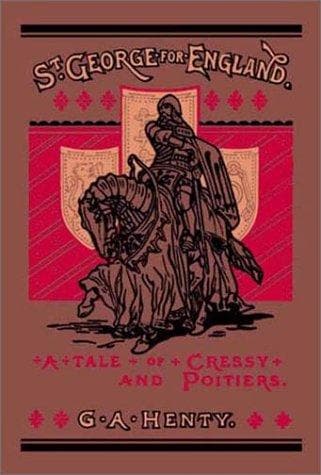
St. George for EnglandHenty, G. A. (George Alfred)
History
St. George for England
Henty, G. A. (George Alfred)
Great Britain -- History -- Edward III, 1327-1377 -- Fiction
This was a breach of the treaty of Bretigny, and De Montford at once
sent to the Black Prince for assistance. The Prince did not treat the
conduct of Charles as a breach of the treaty, and took no part himself
in the war, but permitted Sir John Chandos, who was a personal friend of
De Montford, to go to his aid. De Montford's army, after the arrival of
Chandos with 200 spears, amounted to but 1600 men-at-arms and from
800 to 900 archers, while Charles of Blois had 4000 men-at-arms and a
proportionate number of infantry. De Montford tried to negotiate.
He offered to divide the dukedom, and to agree that in case he died
childless it should revert to the family of Charles. Charles, however,
refused all terms, even to grant his adversary's request to put off
the battle until the morrow, so as to avoid violating the Sabbath; and
having given orders that all prisoners taken in the battle should be
hung, he advanced upon De Montford.
Both forces were divided in four bodies. The first on De Montford's side
was commanded by Sir Robert Knolles, the second by Oliver de Clisson,
the third by Chandos and De Montford, the fourth by Sir Hugh de
Calverley. Du Guesclin led the front division of Charles's army, the
Counts of Auxerre and Joigny the second, Charles himself the third, and
the Lords of Roye and Rieux the reserve. The ducal arms of Brittany were
displayed on both sides.
By slow degrees the two armies closed with each other in deadly strife.
Both parties had dismounted and fought on foot with lances shortened
to five feet. Du Guesclin and his division attacked that of Knolles.
Auxerre fell upon De Clisson, while the divisions of the two rival
princes closed with each other. After desperate fighting numbers
prevailed. De Montford was driven back, but Calverley advanced to his
aid, fell upon the rear of the French, threw them into disorder, and
then having rallied De Montford's men, retired to his former position in
readiness to give succour again where it might be needed.
In the meantime Clisson had been engaged in a desperate struggle with
the Count of Auxerre, but was obtaining no advantage. Clisson himself
had received the blow of a battle-axe which had dashed in the vizor of
his helmet and blinded for ever one of his eyes. He was still leading
his men, but the enemies' superior numbers were pressing him back,
when Chandos, the instant the assistance of Calverley had relieved De
Montford's division, perceiving his danger, drew off a few men-at-arms,
and with them fell upon the rear of the Count of Auxerre, and dashing
all who opposed him to the ground with his battle-axe, cleft his way to
the very centre of the enemy. Pressed by De Clisson in front and broken
by the sudden attack of Chandos in the rear, the French division gave
way in every direction. Auxerre was desperately wounded, and he and
Joigny both taken prisoners.
Public-domain text, read in full here on John Shaqi.
Reviews
Reviews
No reviews yet
Be the first to share your thoughts on this work.
Elsewhere in the archive
Join the Discussion
Join the discussion
Sign in to leave a comment or review.
Sign InorCreate an account