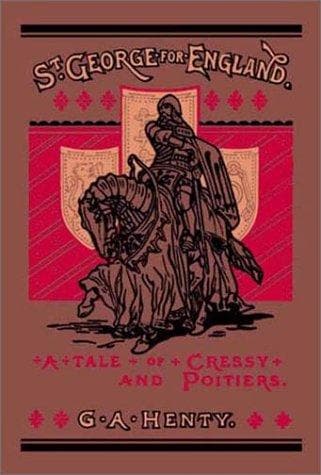
St. George for EnglandHenty, G. A. (George Alfred)
History
St. George for England
Henty, G. A. (George Alfred)
Great Britain -- History -- Edward III, 1327-1377 -- Fiction
Never had Walter crossed swords with a stouter adversary, and his
opponent fought with as much vehemence and fury as if the sight of
Walter's banner, which Ralph carried behind him, had aroused in him a
frenzy of rage and hate. In guarding his head from one of his opponent's
sweeping blows Walter's sword shivered at the hilt; but before the Gray
Knight could repeat the blow Walter snatched his heavy battle-axe
from his saddle. The knight reined back his horse for an instant,
and imitated his example, and with these heavy weapons the fight was
renewed. The Knight of the Raven had lost by the change, for Walter's
great strength stood him in good stead, and presently with a tremendous
blow he beat down his opponent's axe and cleft through his helmet almost
to the chin.
The knight fell dead from his horse, and Walter, with his band pressing
on, carried confusion into the ranks of his followers. When these had
been defeated Walter rode back with Ralph to the spot where the Knight
of the Raven had fallen.
“Take off his helmet, Ralph. Let me see his face. Methinks I recognized
his voice, and he fought as if he knew and hated me.”
Ralph removed the helmet.
“It is as I thought,” Walter said; “it is Sir James Carnegie, a recreant
and villain knight and foul enemy of mine, a disgrace to his name and
rank, but a brave man. So long as he lived I could never say that my
life was safe from his machinations. Thank God, there is an end of him
and his evil doings!”
Walter was twice wounded in the fight, but upon neither occasion
seriously, and he was soon able to take part in the tournaments and
games which the Prince of Wales instituted partly to keep his men
employed, partly for the amusement of the citizens of Burgos, outside
whose walls his army lay encamped.
The prince was now obliged to remind the king of his promise to pay his
troops; but nothing was farther from the mind of the treacherous monarch
than to carry out the promises which he had made in exile. He dared not,
however, openly avow his intentions; but, trusting to the chapter of
accidents, he told the prince that at Burgos he could not collect a
sufficient sum; but if the army would march into Leon and take up their
quarters near Valladolid, he himself would proceed to Seville, and would
as soon as possible collect the money which he had bound himself to
furnish. The plan was adopted. Edward marched his troops to Valladolid,
and Don Pedro went to Seville.
Some time passed on without the arrival of the promised money, and the
prince was impatient to return to Aquitaine. Don Henry had gathered a
force in France, secretly assisted by the French king, and had made
an inroad into Aquitaine, where he obtained several successes, and was
joined by many of the disinterested nobles of that province.
Public-domain text, read in full here on John Shaqi.
Reviews
Reviews
No reviews yet
Be the first to share your thoughts on this work.
Elsewhere in the archive
Join the Discussion
Join the discussion
Sign in to leave a comment or review.
Sign InorCreate an account