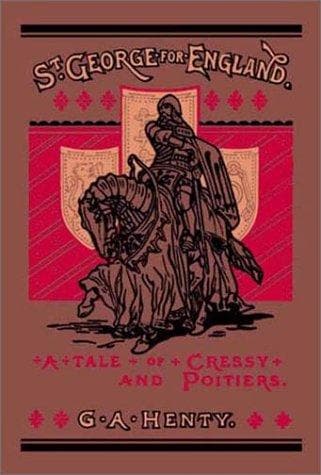
St. George for EnglandHenty, G. A. (George Alfred)
History
St. George for England
Henty, G. A. (George Alfred)
Great Britain -- History -- Edward III, 1327-1377 -- Fiction
“You were right,” the prince said to Walter one day; “this treacherous
king, who owes his kingdom to us, intends to break his plighted word. I
know not what to do; my men are clamorous for their pay, and I am unable
to satisfy them. Don Pedro still sends fair promises, and although I
believe in my heart that he has no intention of keeping them, yet I can
hardly march against him as an enemy, for, however far from the truth it
may be, his pretext that the treasury has been emptied by his brother,
and that in the disturbed state of the kingdom no money can be obtained,
may yet be urged as valid.”
Scarcely had the army encamped before Valladolid when a terrible
pestilence attacked the army. For a while all questions of pay were
forgotten, and consternation and dismay seized the troops. Neither rank
nor station was of avail, and the leaders suffered as severely as the
men. Every day immense numbers died, and so sudden were the attacks, and
so great the mortality, that the soldiers believed that Don Pedro
had poisoned the wells in order to rid himself of the necessity of
fulfilling his obligations.
The Black Prince himself was prostrated, and lay for some time between
life and death. A splendid constitution enabled him to pull through,
but he arose from his bed enfeebled and shattered, and although for
some years he lived on, he received his death-blow at Valladolid. His
personal strength never came to him again, and even his mind was dulled
and the brightness of his intellect dimmed from the effects of the
fever. When he recovered sufficiently to inquire into the state of his
forces, he was filled with sorrow and dismay. Four-fifths of the number
were either dead or so weakened as to be useless for service again. The
prince wrote urgently to Don Pedro for the money due; but the king knew
that the English were powerless now, and replied that he had not been
able to collect the money, but would forward it to Aquitaine, if the
prince would return there with his army. Edward knew that he lied, but
with only 6000 or 7000 men, many of whom were enfeebled by disease,
he was not in a position to force the claim, or to punish the base and
ungrateful king. Again, therefore, he turned his face north.
Charles of Navarre had now allied himself with Don Henry, and refused to
allow the remnants of the army to pass through his dominions, although
he granted permission to the prince himself and his personal attendants
and friends. The southern route was barred by the King of Arragon, also
an ally of Don Henry; but with him the prince was more successful. He
had a personal interview with the monarch, and so influenced him that
he not only obtained permission for his troops to pass through his
dominions, but detached him from his alliance with Don Henry, and
induced him to enter into a friendly treaty with Pedro.
Public-domain text, read in full here on John Shaqi.
Reviews
Reviews
No reviews yet
Be the first to share your thoughts on this work.
Elsewhere in the archive
Join the Discussion
Join the discussion
Sign in to leave a comment or review.
Sign InorCreate an account