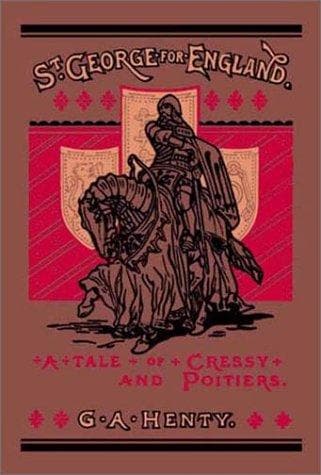
St. George for EnglandHenty, G. A. (George Alfred)
History
St. George for England
Henty, G. A. (George Alfred)
Great Britain -- History -- Edward III, 1327-1377 -- Fiction
“So far the king had acquiesced quietly in the authority of his mother,
but he now paid a visit to France, and doubtless the barons around
him there took advantage of his absence from her tutelage to shake her
influence over his mind; and at the same time a rising took place at
home against her authority. This was suppressed, and the Earl of Kent,
the king's uncle, was arrested and executed by Isabella. This act
of severity against his uncle, no doubt, hastened the prince's
determination to shake off the authority of his haughty mother and to
assume the reins of government himself. The matter, however, was not
easy to accomplish. Mortimer having the whole of the royal revenue at
his disposal, had attached to himself by ties of interest a large number
of barons, and had in his pay nearly two hundred knights and a large
body of men-at-arms. Thus it was no easy matter to arrest him. It was
determined that the deed should be done at the meeting of the parliament
at Nottingham. Here Mortimer appeared with Isabella in royal pomp. They
took their abode at the castle, while the king and other members of the
royal family were obliged to content themselves with an inferior place
of residence.
“The gates of the castle were locked at sunset, and the keys brought by
the constable, Sir William Eland, and handed to the queen herself. This
knight was a loyal and gallant gentleman, and regarded Mortimer with no
affection, and when he received the king's commands to assist the barons
charged to arrest him he at once agreed to do so. He was aware of the
existence of a subterranean communication leading from the interior of
the castle to the outer country, and by this, on the night of the 19th
of October, 1330, he led nine resolute knights--the Lords Montague,
Suffolk, Stafford, Molins, and Clinton, with three brothers of the name
of Bohun, and Sir John Nevil--into the heart of the castle. Mortimer was
found surrounded by a number of his friends. On the sudden entry of the
knights known to be hostile to Mortimer his friends drew their swords,
and a short but desperate fight took place. Many were wounded, and Sir
Hugh Turpleton and Richard Monmouth were slain. Mortimer was carried
to London, and was tried and condemned by parliament, and executed for
felony and treason. Several of his followers were executed, and others
were attacked in their strongholds and killed; among these was Sir
Roland Somers.
Public-domain text, read in full here on John Shaqi.
Reviews
Reviews
No reviews yet
Be the first to share your thoughts on this work.
Join the Discussion
Join the discussion
Sign in to leave a comment or review.
Sign InorCreate an account