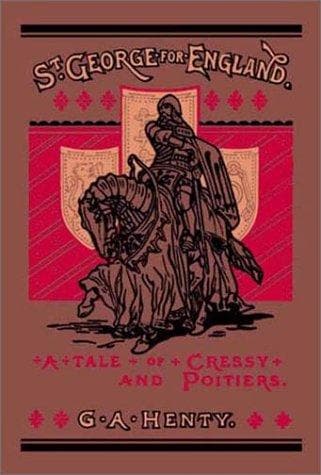
St. George for EnglandHenty, G. A. (George Alfred)
History
St. George for England
Henty, G. A. (George Alfred)
Great Britain -- History -- Edward III, 1327-1377 -- Fiction
So saying, he took down his flat cap from its peg on the wall and went
out, while his sister at once proceeded to remove the drenched
garments and to rub the cold hands of the guest until she recovered
consciousness. When Geoffrey Ward returned, the woman was sitting in a
settle by the fireside, dressed in a warm woolen garment belonging to
his sister.
Madge had thrown fresh wood on the fire, which was blazing brightly now.
The woman drank the steaming beverage which her host brought with him.
The colour came faintly again into her cheeks.
“I thank you, indeed,” she said, “for your kindness. Had you not taken
me in I think I would have died at your door, for indeed I could go no
further; and though I hold not to life, yet would I fain live until I
have delivered my boy into the hands of those who will be kind to him,
and this will, I trust, be tomorrow.”
“Say nought about it,” Geoffrey answered; “Madge and I are right glad
to have been of service to you. It would be a poor world indeed if one
could not give a corner of one's fireside to a fellow-creature on such
a night as this, especially when that fellow creature is a woman with
a child. Poor little chap! He looks right well and sturdy, and seems to
have taken no ill from his journey.”
“Truly, he is well and sturdy,” the mother said, looking at him proudly;
“indeed I have been almost wishing today that he were lighter by a few
pounds, for in truth I am not used to carry him far, and his weight has
sorely tried me. His name is Walter, and I trust,” she added, looking at
the powerful figure of her host, “that he will grow up as straight and
as stalwart as yourself.” The child, who was about three years old,
was indeed an exceedingly fine little fellow, as he sat, in one scanty
garment, in his mother's lap, gazing with round eyes at the blazing
fire; and the smith thought how pretty a picture the child and mother
made. She was a fair, gentle-looking girl some two-and-twenty years old,
and it was easy enough to see now from her delicate features and soft
shapely hands that she had never been accustomed to toil.
“And now,” the smith said, “I will e'en say good night. The hour is
late, and I shall be having the watch coming along to know why I keep a
fire so long after the curfew. Should you be a stranger in the city,
I will gladly act as your guide in the morning to the friends whom
you seek, that is, should they be known to me; but if not, we shall
doubtless find them without difficulty.”
So saying, the smith retired to his bed of rushes in the smithy, and
soon afterwards the tired visitor, with her baby, lay down on the rushes
in front of the fire, for in those days none of the working or artisan
class used beds, which were not indeed, for centuries afterwards, in
usage by the common people.
In the morning Geoffrey Ward found that his guest desired to find one
Giles Fletcher, a maker of bows.
Public-domain text, read in full here on John Shaqi.
Reviews
Reviews
No reviews yet
Be the first to share your thoughts on this work.
Join the Discussion
Join the discussion
Sign in to leave a comment or review.
Sign InorCreate an account