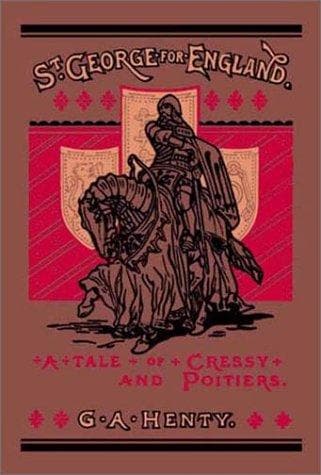
St. George for EnglandHenty, G. A. (George Alfred)
History
St. George for England
Henty, G. A. (George Alfred)
Great Britain -- History -- Edward III, 1327-1377 -- Fiction
“At the time of the death of the last king, Edward was still but a boy
under the tuition of his mother, Phillip was a man, and upon the spot,
therefore he was able to win support by presence and promises, and so
it came that the peers of France declared Phillip of Valois to be their
rightful monarch. Here in England, at parliament held at Northampton,
the rights of Edward were discussed and asserted, and the Bishops of
Worcester and Coventry were despatched to Paris to protest against the
validity of Phillip's nomination. As, however, the country was not in
a position to enforce the claim of their young king by arms, Phillip
became firmly seated as King of France, and having shown great energy in
at once marching against and repressing the people of Flanders, who were
in a state of rebellion against their count, one of the feudatories of
the French crown, the nobles were well satisfied with their choice, and
no question as to his right was ever henceforth raised in France. As
soon as the rebellion in Flanders was crushed, Phillip summoned the King
of England to do homage for Aquitaine, Ponthieu and Montreuil, fiefs
held absolutely from the crown of France. Such a proceeding placed
Edward and his council in a great embarrassment. In case of a refusal
the whole of the possessions of the crown in France might be declared
forfeited and be seized, while England was in no condition to defend
them; on the other hand, the fact of doing homage to Phillip of Valois
would be a sort of recognition of his right to the throne he had
assumed. Had Edward then held the reins of power in his hands, there
can be little doubt that he would at once have refused, and would have
called out the whole strength of England to enforce his claim. The
influence of Isabella and Mortimer was, however, all powerful, and
it was agreed that Edward should do homage as a public act, making a
private reservation in secret to his own councillors, taking exception
to the right of Phillip.
“Edward crossed to France and journeyed to Amiens, where Phillip with
a brilliant court awaited him, and on the appointed day they appeared
together in the cathedral. Here Edward, under certain protestations, did
homage for his French estates, leaving certain terms and questions open
for the consideration of his council. For some time the matter remained
in this shape; but honest men cannot but admit that King Edward did, by
his action at the time, acknowledge Phillip to be King of France, and
that he became his vassal for his estates there; but, as has happened
scores of times before, and will no doubt happen scores of times again,
vassals, when they become powerful enough, throw off their allegiance to
their feudal superiors, and so the time came to King Edward.
Public-domain text, read in full here on John Shaqi.
Reviews
Reviews
No reviews yet
Be the first to share your thoughts on this work.
Join the Discussion
Join the discussion
Sign in to leave a comment or review.
Sign InorCreate an account