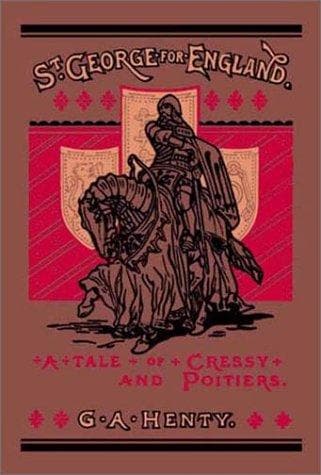
St. George for EnglandHenty, G. A. (George Alfred)
History
St. George for England
Henty, G. A. (George Alfred)
Great Britain -- History -- Edward III, 1327-1377 -- Fiction
“That is more than I can tell you, Walter. We were peaceful enough with
them until the days of Edward I; but he set up some claim to the throne
of Scotland, the rights of which neither I nor anyone else, so far as I
know, have ever been able to make out. The fact was he was strong,
and thought that he could conquer Scotland. The quarrels between
her nobles--most of them were allied by blood with our own and held
possessions in both kingdoms--gave Edward an excuse to interfere.
Scotland was conquered easily enough, but it was a hard task to hold it.
Sir William Wallace kept the country in a turmoil for many years, being
joined by all the common people. He inflicted one heavy defeat upon us
at Stirling, but receiving no support from the nobles he was defeated at
Falkirk, and some years afterwards was captured and executed here. His
head you may see any day over London Bridge. As he fought only for his
country and had ever refused allegiance to our king, it seems to me that
his fate was a cruel one. Then when all appeared quiet, Robert Bruce
raised Scotland again, and was crowned king. There was war for many
years, but at last, at Bannockburn he inflicted such a defeat upon us
as we have never had before. After that there were skirmishes and
excursions, but Edward II was a weak prince, and it seemed that the
marriage of David and the Princess Joan would bring about a permanent
peace between the two countries; but it was not to be so.”
“Many of the English nobles held claims by marriage or grants upon
lands in Scotland. They had, of course, been driven from these when the
English were turned out by Bruce. By the terms of the marriage treaty
in 1328 it was agreed that they should be reinstated. It was a foolish
clause, because it was plain that the King of Scotland could not take
these lands again from the Scotch nobles who had possession of them,
many of them being well-nigh as powerful as himself. At this time Edward
Baliol, son of the great rival of Robert Bruce, was in England. He still
claimed the throne of Scotland as his right. Round him gathered a number
of the English nobles who claimed lands in Scotland. The king offered
no hindrance to the gathering of this force, for I doubt not that he
was glad to see dissension in Scotland, which might give him some such
pretext for interference as that which Edward I had seized to possess
himself of that country. At first Baliol was successful, and was crowned
at Scone, but he was presently defeated and driven out of Scotland.
The Scots now made an eruption across the frontier as a retaliation
for Edward's having permitted Baliol to gather a force here for his war
against Bruce. King Edward was on the point of starting for Ireland,
and he at once hastened north. He defeated the Scots at Halidon Hill,
captured Berwick, and placed Baliol upon the throne. Bruce fled to
France, where he was supported and encouraged by the French king.”
Public-domain text, read in full here on John Shaqi.
Reviews
Reviews
No reviews yet
Be the first to share your thoughts on this work.
Join the Discussion
Join the discussion
Sign in to leave a comment or review.
Sign InorCreate an account