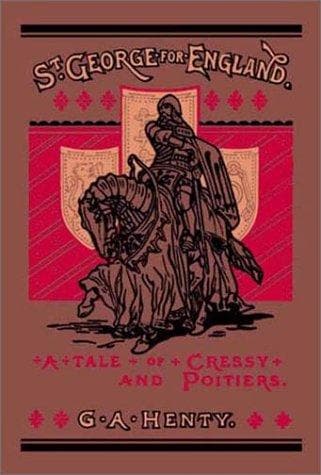
St. George for EnglandHenty, G. A. (George Alfred)
History
St. George for England
Henty, G. A. (George Alfred)
Great Britain -- History -- Edward III, 1327-1377 -- Fiction
They passed under the gateway, with its ghastly burden, and were soon in
the crowded streets of London. High overhead the houses extended, each
story advancing beyond that below it until the occupiers of the attics
could well-nigh shake hands across. They soon left the more crowded
streets, and turning to the right, after ten minutes walking, the smith
stopped in front of a bowyer shop near Aldgate.
“This is the shop,” he said, “and there is Giles Fletcher himself trying
the spring and pull of one of his bows. Here I will leave you, and will
one of these days return to inquire if your health has taken ought of
harm by the rough buffeting of the storm of yester-even.”
So saying he handed the child to its mother, and with a wave of the hand
took his leave, not waiting to listen to the renewed thanks which his
late guest endeavoured to give him.
The shop was open in front, a projecting penthouse sheltered it from the
weather; two or three bows lay upon a wide shelf in front, and several
large sheaves of arrows tied together stood by the wall. A powerful man
of some forty years old was standing in the middle of the shop with a
bent bow in his arm, taking aim at a spot in the wall. Through an open
door three men could be seen in an inner workshop cutting and shaping
the wood for bows. The bowyer looked round as his visitor entered the
shop, and then, with a sudden exclamation, lowered the bow.
“Hush, Giles!” the lady exclaimed; “it is I, but name no names; it were
best that none knew me here.”
The craftsman closed the door of communication into the inner room.
“My Lady Alice,” he exclaimed in a low tone, “you here, and in such a
guise?”
“Surely it is I,” the lady sighed, “although sometimes I am well-nigh
inclined to ask myself whether it be truly I or not, or whether this be
not all a dreadful dream.”
“I had heard but vaguely of your troubles,” Giles Fletcher said, “but
hoped that the rumours were false. Ever since the Duke of Kent was
executed the air has been full of rumours. Then came news of the killing
of Mortimer and of the imprisonment of the king's mother, and it was
said that many who were thought to be of her party had been attacked and
slain, and I heard--” and there he stopped.
Public-domain text, read in full here on John Shaqi.
Reviews
Reviews
No reviews yet
Be the first to share your thoughts on this work.
Join the Discussion
Join the discussion
Sign in to leave a comment or review.
Sign InorCreate an account