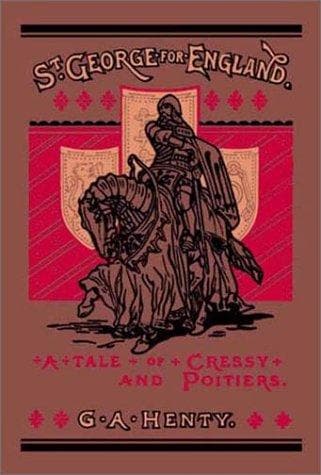
St. George for EnglandHenty, G. A. (George Alfred)
History
St. George for England
Henty, G. A. (George Alfred)
Great Britain -- History -- Edward III, 1327-1377 -- Fiction
The next day all London poured out to the scene of the sports, and the
greatest admiration and wonder were expressed at the castle, which had
risen, as if by magic, in the night. It was built at one end of the
lists, which had been purposely placed in a hollow, so that a great
number of people besides those in the pavilions could obtain a view
from the surrounding slopes. The castle was substantially built of heavy
timber painted gray, and looked at a little distance as if constructed
of stone. A flag floated from the central tower, and the building looked
so formidable that the general opinion was freely expressed that the
task of the assailants, whoever they might be--for at present this was
unknown--was quite impossible. At ten o'clock the king and his court
arrived. After they had taken their places the two bands, headed by
their leaders, advanced from the lower end of the lists, and drew up
in front of the royal pavilion. The leaders took their places in front.
Behind them stood ten chosen followers, all of whom, as well as their
chiefs, were encased in full armour. Behind, on one side, were 100
apprentices, on the other 100 esquires, all attired as men-at-arms. The
court party were led by Clarence Aylmer, son of the Earl of Pembroke.
His companions were all young men of noble family, aspirants for the
order of knighthood. They were, for the most part, somewhat older than
the apprentices, but as the latter consisted chiefly of young men nearly
out of their term the difference was not great. Walter's armour was a
suit which the armourer had constructed a year previously for a young
knight who had died before the armour could be delivered. Walter had
wondered more than once why Geoffrey did not endeavour to sell it
elsewhere, for, although not so decorated and inlaid as many of the
suits of Milan armour, it was constructed of the finest steel, and the
armourer had bestowed special care upon its manufacture, as the young
knight's father had long been one of his best customers. Early that
morning Geoffrey had brought it to his room and had told him to wear it
instead of that lent by the city.
“But I fear it will get injured,” Walter had urged. “I shall not spare
myself, you know, Geoffrey, and the blows will be hard ones.
“The more need for good armour, Walter. These city suits are made for
show rather than use. You may be sure that young Pembroke and his band
will fight their hardest rather than suffer defeat at the hands of those
whom they consider a band of city varlets.”
Before issuing from the tent where he and his companions had put on
their mail Walter carefully fastened in the front of his helmet a tiny
gold bracelet. Upon taking their places before the pavilion the king
ordered the two leaders to advance, and addressed them and the multitude
in the following words:
Public-domain text, read in full here on John Shaqi.
Reviews
Reviews
No reviews yet
Be the first to share your thoughts on this work.
Join the Discussion
Join the discussion
Sign in to leave a comment or review.
Sign InorCreate an account