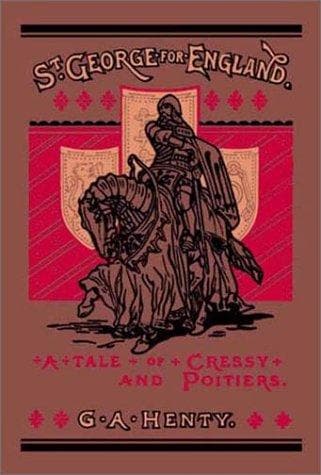
St. George for EnglandHenty, G. A. (George Alfred)
History
St. George for England
Henty, G. A. (George Alfred)
Great Britain -- History -- Edward III, 1327-1377 -- Fiction
There was a movement of surprise and a general smile. Perhaps to all
who thought that they had a chance of being chosen the selection was a
relief, as none could be jealous of the pretty child, who, at the king's
order, made her way forward to the front, and took her seat in a chair
placed between the king and queen. The girl coloured brightly; but she
had heard so much of tourneys and jousts that she knew what was her
duty. She had been sitting far back on the previous day, and the
apprentice, when brought up before the king, was too far below for her
to see his features. She now recognized him.
“Sir Knights,” she said in a loud, clear, childish voice, “you will both
do your duty today and show yourselves worthy cavaliers. Methinks that,
as queen of the tourney, I should be neutral between you, but as one of
you carries my gage in his helm, my good wishes must needs go with him;
but bright eyes will be fixed on you both, and may well stir you to
deeds of valour.”
So saying, she resumed her seat with a pretty air of dignity.
“Why, sweetheart,” the king said, “how is it that this 'prentice lad
knows your name, and how is it that he wears your gage, for I know that
the young Pembroke wears the glove of the Earl of Surrey's daughter?”
“He saved my life, sir, mine and my mother's,” the child said, “and I
told him he should be my true knight, and gave him my bracelet, which
you see he wears in his helm.”
“I recall somewhat of the story,” the king said, “and will question
my Lady Vernon further anon; but see, the combatants are filing off to
their places.”
With flags flying and trumpets blowing young Pembroke led his forces
into the castle. Each of his ten knights was followed by an esquire
bearing his banner, and each had ten men-at-arms under his immediate
order. Two of them, with twenty men, remained in the outwork beyond the
drawbridge. The rest took their station on the walls, and towers,
where a platform had been erected, running along three feet below the
battlements. The real men-at-arms with the machines of war now advanced,
and for a time worked the machines, which made pretence at casting great
stones and missiles at the walls. The assailants then moved forward and,
unslinging their bows, opened a heavy fire of arrows at the defenders,
who, in turn, replied with arrows and cross-bows.
“The 'prentices shoot well,” the king said; “by our lady, it would be
hot work for the defenders were the shafts but pointed! Even as it
is the knocks must be no child's play, for the arrows, although not
pointed, are all tipped with iron, without which, indeed, straight
shooting would be impossible.”
Public-domain text, read in full here on John Shaqi.
Reviews
Reviews
No reviews yet
Be the first to share your thoughts on this work.
Join the Discussion
Join the discussion
Sign in to leave a comment or review.
Sign InorCreate an account