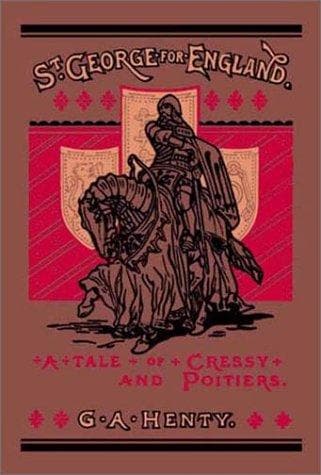
St. George for EnglandHenty, G. A. (George Alfred)
History
St. George for England
Henty, G. A. (George Alfred)
Great Britain -- History -- Edward III, 1327-1377 -- Fiction
From the tower above, the defenders now hurled over great stones,
which had been specially placed there for the purpose of destroying
the drawbridge should the earthwork be carried. The boards were soon
splintered, and the drawbridge was pronounced by the Earl of Talbot, who
was acting as judge, to be destroyed. The excitement of the spectators
was worked up to a great pitch while the conflict was going on, and the
citizens cheered lustily at the success of the apprentices.
“That was gallantly done,” the king said to Queen Philippa, “and the
leader of the assailants is a lad of rare mettle. Not a captain of
my army, no, not Sir Walter Manny himself, could have done it more
cleverly. You see, by placing his forces at the ends of the wall he drew
all the garrison thither to withstand the assaults from them, and thus
by his sudden movement he was able to carry the outwork before they
could recover from their surprise, and come down to its aid. I am
curious to know what he will do next. What thinkst thou, Edward?” he
asked his son, who was standing by his side.
“He will win the day,” the young prince said; “and in faith, although
the others are my comrades, I should be glad to see it. He will make a
gallant knight, sir, one of these days, and remember he is engaged to
follow my banner, so you must not steal him from me. See, my liege, they
are taking planks and ladders to the outwork.”
“They are doing wrongly then,” the king said, “for even should they
bridge the moat where the drawbridge is, they cannot scale the wall
there, since the tower defends it, and the ladders are but long enough
to reach the lower wall. No, their leader has changed his mind, they are
taking the planks along the edge of the moat towards the tower on the
left, and will aid the assault by its bridge by a passage of the moat
there.”
It seemed, indeed, that this was the plan. While some of the assailants
kept up the arrow fire on the wall others mounted the tower, while a
party prepared to throw a bridge of planks across the moat. The bridge
from the tower was now lowered; but a shout of triumph rose from the
defenders when it was seen that by some mistake of the carpenters this
was too short, and when lowered did not reach within six feet of the
wall.
“All the better,” the king said, while the prince gave an angry
exclamation. “Accidents of this kind will happen, and give an
opportunity to a leader to show his resources. Doubtless he will carry
planks up to the tower and so connect the bridge and the wall.”
This, indeed, was what the assailants tried to do, while a party threw
planks across the moat, and rushing over placed ladders against the
wall and strove to climb. They strove in vain, however. The ladders were
thrown down as fast as they were placed, while the defenders, thickly
clustered on the walls, drove back those who tried to cross from the
tower.
“I do not see the leader of the assailants,” the prince said.
Public-domain text, read in full here on John Shaqi.
Reviews
Reviews
No reviews yet
Be the first to share your thoughts on this work.
Join the Discussion
Join the discussion
Sign in to leave a comment or review.
Sign InorCreate an account