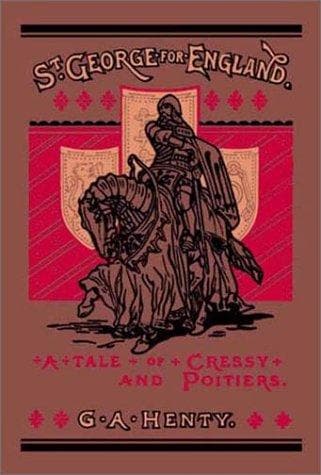
St. George for EnglandHenty, G. A. (George Alfred)
History
St. George for England
Henty, G. A. (George Alfred)
Great Britain -- History -- Edward III, 1327-1377 -- Fiction
Geoffrey Ward laughed. “Trust a woman for being romantic,” he said.
“However, Master Fletcher, you need not for the present trouble about
the child's calling, even should its mother die. At any rate, whether he
follows your trade, or whether the blood in his veins leads him to take
to martial deeds, the knowledge of arms may well be of use to him, and I
promise you that such skill as I have I will teach him when he grows
old enough to wield sword and battle-axe. As you know I may, without
boasting, say that he could scarce have a better master, seeing that I
have for three years carried away the prize for the best sword-player
at the sports. Methinks the boy will grow up into a strong and stalwart
man, for he is truly a splendid lad. As to archery, he need not go far
to learn it, since your apprentice, Will Parker, last year won the prize
as the best marksman in the city bounds. Trust me, if his tastes lie
that way we will between us turn him out a rare man-at-arms. But I must
stand gossiping no longer; the rumours that we are likely ere long to
have war with France, have rarely bettered my trade. Since the wars in
Scotland men's arms have rusted somewhat, and my two men are hard at
work mending armour and fitting swords to hilts, and forging pike-heads.
You see I am a citizen though I dwell outside the bounds, because house
rent is cheaper and I get my charcoal without paying the city dues. So I
can work somewhat lower than those in the walls, and I have good custom
from many in Kent, who know that my arms are of as good temper as those
turned out by any craftsman in the city.”
Giles Fletcher's anticipations as to the result of his guest's illness
turned out to be well founded. The fever abated, but left her prostrate
in strength. For a few weeks she lingered; but she seemed to have little
hold of life, and to care not whether she lived or died. So, gradually
she faded away.
“I know you will take care of my boy as if he were your own, Bertha,”
she said one day; “and you and your husband will be far better
protectors for him than I should have been had I lived. Teach him to be
honest and true. It were better, methinks, that he grew up thinking you
his father and mother, for otherwise he may grow discontented with
his lot; but this I leave with you, and you must speak or keep silent
according as you see his disposition and mind. If he is content to
settle down to a peaceful life here, say nought to him which would
unsettle his mind; but if Walter turn out to have an adventurous
disposition, then tell him as much as you think fit of his history, not
encouraging him to hope to recover his father's lands and mine, for that
can never be, seeing that before that time can come they would have been
enjoyed for many years by others; but that he may learn to bear himself
bravely and gently as becomes one of good blood.”
Public-domain text, read in full here on John Shaqi.
Reviews
Reviews
No reviews yet
Be the first to share your thoughts on this work.
Join the Discussion
Join the discussion
Sign in to leave a comment or review.
Sign InorCreate an account