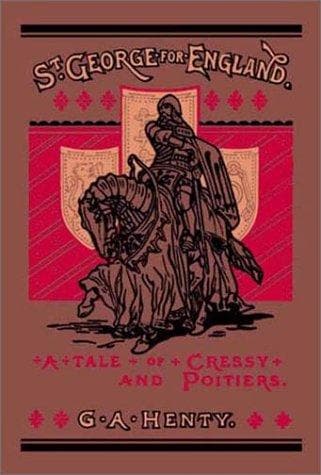
St. George for EnglandHenty, G. A. (George Alfred)
History
St. George for England
Henty, G. A. (George Alfred)
Great Britain -- History -- Edward III, 1327-1377 -- Fiction
For a few minutes the conflict was desperate and many on both sides were
overthrown; then, as large reinforcements were continually arriving
to the French, Sir Walter called off his men and retired slowly.
On reaching the moat he halted his forces. The knights wheeled and
presented a firm face to the enemy, covering the entrance of their
followers into the gate. The French chivalry thundered down upon the
little body, but were met by a storm of arrows from the archers lining
the moat. Many knights were struck through the bars of their vizors or
the joints of their mail. The horses, though defended by iron trappings,
fell dead under them, or, maddened by pain, dashed wildly through the
ranks, carrying confusion with them, and the French commanders, seeing
how heavy were their losses, called off their men from the assault. Sir
Walter Manny with his party remained without the gate until the
enemy had re-entered their camp, and then rode into the town amid
the acclamations of the inhabitants, the countess herself meeting her
deliverers at the gate and kissing each, one after the other, in token
of her gratitude and admiration.
The arrival of the reinforcements and the proof of skill and vigour
given by the English leader, together with the terror caused by the
terrible effect of the English arrows, shook the resolution of Don Louis
and his troops. Deprived of half their force by the absence of Charles
of Blois, it was thought prudent by the leaders to withdraw at once, and
the third morning after the arrival of Sir Walter Manny the siege was
raised, and the French marched to join Charles of Blois before the
Castle of Auray.
Even with the reinforcements brought by Sir Walter Manny, the forces of
the Countess of Montford were still so greatly inferior to those of the
divisions of the French army that they could not hope to cope with them
in the field until the arrival of the main English army, which the King
of England himself was to bring over shortly. Accordingly the French
laid siege to and captured many small towns and castles. Charles of
Blois continued the siege of Auray, and directed Don Louis with his
division to attack the town of Dinan. On his way the Spaniard captured
the small fortress of Conquet and put the garrison to the sword. Sir
Walter Manny, in spite of the inferiority of his force, sallied out
to relieve it, but it was taken before his arrival, and Don Louis had
marched away to Dinan, leaving a small garrison in Conquet. It was again
captured by Sir Walter, but finding it indefensible he returned with
the whole of his force to Hennebon. Don Louis captured Dinan and then
besieged Guerande. Here he met with a vigorous resistance, but carried
it by storm, and gave it up to be pillaged by his soldiers. He now
sent back to Charles of Blois the greater part of the French troops
who accompanied him, and embarked with the Genoese and Spanish, 8000
in number, and sailed to Quimperle, a rich and populous town in Lower
Brittany.
Public-domain text, read in full here on John Shaqi.
Reviews
Reviews
No reviews yet
Be the first to share your thoughts on this work.
Elsewhere in the archive
Join the Discussion
Join the discussion
Sign in to leave a comment or review.
Sign InorCreate an account