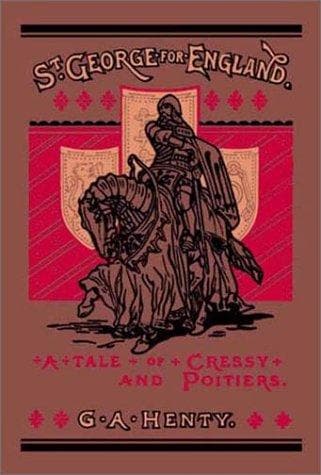
St. George for EnglandHenty, G. A. (George Alfred)
History
St. George for England
Henty, G. A. (George Alfred)
Great Britain -- History -- Edward III, 1327-1377 -- Fiction
Anchoring in the River Leita, he disembarked his troops, and leaving
a guard to protect the vessels marched to the interior, plundering
and burning, and from time to time despatching his booty to swell
the immense mass which he had brought in his ships from the sack of
Guerande.
Quimperle lies but a short distance from Hennebon, and Sir Walter Manny
with Almeric de Clisson, a number of English knights, and a body of
English archers, in all three thousand men, embarked in the ships in
the port, and entering the Leita captured the enemy's fleet and all his
treasure. The English then landed, and dividing into three bodies, set
out in search of the enemy.
The English columns marched at a short distance apart so as to be able
to give each other assistance in case of attack. The news of the English
approach soon reached the Spaniards, who were gathered in a solid body,
for the enraged country people, armed with clubs and bills, hung on
their flanks and cut off any stragglers who left the main body. Don
Louis at once moved towards the sea-coast, and coming in sight of one of
the English divisions, charged it with his whole force.
The English fought desperately, but the odds of seven to one were
too great, and they would have been overpowered had not the other two
divisions arrived on the spot and fallen upon the enemy's flanks.
After a severe and prolonged struggle the Genoese and Spaniards were
completely routed. The armed peasantry slew every fugitive they could
overtake, and of the 7000 men with whom Don Louis commenced the battle
only 300 accompanied him in his flight to Rennes, the troops of Sir
Walter and de Clisson pursuing him to the very gates of that city. Sir
Walter marched back with his force to the ships, but finding the wind
unfavourable returned to Hennebon by land, capturing by the way the
castle of Goy la Foret. Their return was joyfully welcomed, not only
for the victory which they had achieved, but because the enemy was again
drawing near to the town. Auray had fallen. The brave garrison, after
existing for some time upon the flesh of their horses, had endeavoured
to cut their way through the besiegers. Most of them were killed in the
attempt, but a few escaped and made their way to Hennebon.
Vannes, an important town, and Carhaix quickly surrendered, and the
French force was daily receiving considerable reinforcements. This arose
from the fact that large numbers of French nobles and knights had, with
their followers, taken part with Alfonso, King of Castile and Leon, in
his war with the Moors. This had just terminated with the expulsion of
the latter from Spain, and the French knights and nobles on their way
home for the most part joined at once in the war which their countrymen
were waging in Bretagne.
Public-domain text, read in full here on John Shaqi.
Reviews
Reviews
No reviews yet
Be the first to share your thoughts on this work.
Elsewhere in the archive
Join the Discussion
Join the discussion
Sign in to leave a comment or review.
Sign InorCreate an account