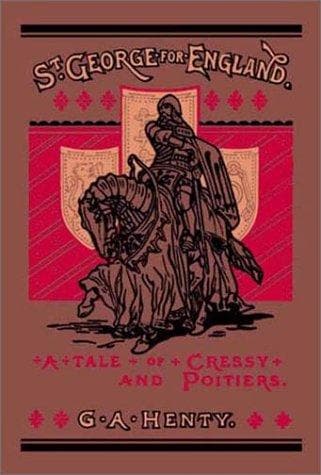
St. George for EnglandHenty, G. A. (George Alfred)
History
St. George for England
Henty, G. A. (George Alfred)
Great Britain -- History -- Edward III, 1327-1377 -- Fiction
The prisoners were sent for, and were informed by Don Louis himself of
their approaching end. At first they could not believe that he was in
earnest, for such a proceeding was so utterly opposed to the spirit
of the times that it seemed impossible to them. Finding that he was in
earnest they warned him of the eternal stain which such a deed would
bring upon his name. The Spaniard, however, was unmoved either by their
words or by the entreaties of the French nobles but told them that he
would give them a few hours to prepare for death, and that they should
be executed in sight of the walls after the usual dinner hour of the
army.
In those days sieges were not conducted in the strict manner in which
they are at present, and non-combatants passed without difficulty to
and fro between town and camp. The news, therefore, of what was intended
speedily reached the garrison, whom it filled with indignation and
horror. A council was immediately called, and Sir Walter Manny proposed
a plan, which was instantly adopted.
Without loss of time Almeric de Clisson issued forth from the great gate
of Hennebon, accompanied by 300 men-at-arms and 1000 archers. The latter
took post at once along the edge of the ditches. The men-at-arms rode
straight for the enemy's camp, which was undefended, the whole army
being within their tents at dinner. Dashing into their midst the English
and Breton men-at-arms began to overthrow the tents and spear all that
were in them. Not knowing the extent of the danger or the smallness of
the attacking force, the French knights sprang up from table, mounted,
and rode to encounter the assailants.
For some time these maintained their ground against all assaults until,
finding that the whole army was upon them, Almeric de Clisson gave order
for his troop to retire slowly upon the town. Fighting every step of the
ground and resisting obstinately the repeated onslaught of the French,
Clisson approached the gate. Here he was joined by the archers, who with
bent bows prepared to resist the advance of the French. As it appeared
that the garrison were prepared to give battle outside the walls, the
whole French army prepared to move against them.
In the meantime Sir Walter Manny, with 100 men-at-arms and 500 horse
archers, issued by a sally-port on the other side of the town, and with
all speed rode round to the rear of the French camp. There he found
none to oppose him save servants and camp-followers, and making his way
straight to the tent of Charles of Blois, where the two knights were
confined, he soon freed them from their bonds. They were mounted without
wasting a moment's time upon two spare horses, and turning again the
whole party rode back towards Hennebon, and had reached the postern gate
before the fugitives from the camp reached the French commanders and
told them what had happened.
Public-domain text, read in full here on John Shaqi.
Reviews
Reviews
No reviews yet
Be the first to share your thoughts on this work.
Elsewhere in the archive
Join the Discussion
Join the discussion
Sign in to leave a comment or review.
Sign InorCreate an account