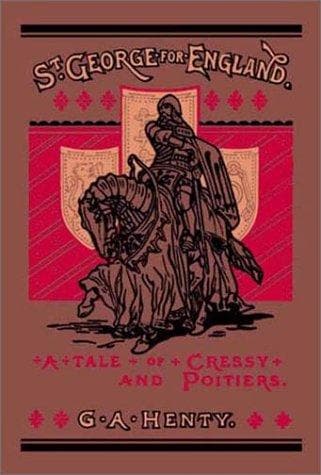
St. George for EnglandHenty, G. A. (George Alfred)
History
St. George for England
Henty, G. A. (George Alfred)
Great Britain -- History -- Edward III, 1327-1377 -- Fiction
Seeing the great force which was gathering for a fresh siege of
Hennebon, Sir Walter Manny and the Countess of Montford sent an urgent
message to King Edward for further support. The king was not yet ready,
but at the beginning of August he despatched a force under the command
of the Earl of Northampton and Robert of Artois. It consisted of
twenty-seven knights bannerets and 2000 men-at-arms. Before, however, it
could reach Hennebon the second siege of that city had begun. Charles of
Blois had approached it with a far larger army than that with which he
had on the first occasion sat down before it. Hennebon was, however,
much better prepared than at first for resistance. The walls had
been repaired, provisions and military stores laid up, and machines
constructed. The garrison was very much larger, and was commanded by
one of the most gallant knights of the age, and the citizens beheld
undaunted the approach of the great French army.
Four days after the French had arrived before Hennebon they were joined
by Don Louis, who had been severely wounded in the fight near Quimperle,
and had lain for six weeks at Rennes. Sixteen great engines at once
began to cast stones against the walls, but Sir Walter caused sandbags
to be lowered, and so protected the walls from the attack that little
damage was done. The garrison confident in their powers to resist,
taunted the assailants from the walls, and specially enraged the
Spaniards and Don Louis by allusions to the defeat at Quimperle.
So furious did the Spanish prince become that he took a step
unprecedented in those days of chivalry. He one morning entered the tent
of Charles of Blois, where a number of French nobles were gathered,
and demanded a boon in requital of all his services. Charles at once
assented, when, to his surprise and horror, Prince Louis demanded that
two English knights, Sir John Butler and Sir Hubert Frisnoy, who had
been captured in the course of the campaign and were kept prisoners at
Faouet, should be delivered to him to be executed. “These English,” he
said, “have pursued, discomforted, and wounded me, and have killed the
nephew whom I loved so well, and as I have none other mode of vengeance
I will cut off their heads before their companions who lie within those
walls.”
Charles of Blois and his nobles were struck with amazement and horror
at the demand, and used every means in their power to turn the savage
prince from his purpose, but in vain. They pointed out to him that his
name would be dishonoured in all countries where the laws of chivalry
prevailed by such a deed, and besought him to choose some other boon.
Don Louis refused to yield, and Charles of Blois, finding no alternative
between breaking his promise and delivering his prisoners, at last
agreed to his request.
Public-domain text, read in full here on John Shaqi.
Reviews
Reviews
No reviews yet
Be the first to share your thoughts on this work.
Elsewhere in the archive
Join the Discussion
Join the discussion
Sign in to leave a comment or review.
Sign InorCreate an account