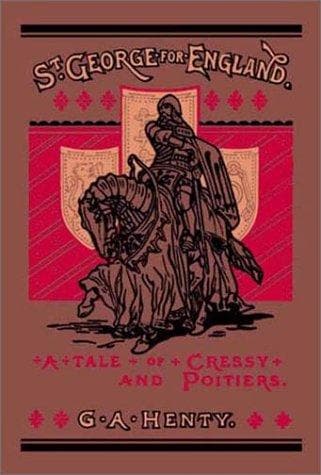
St. George for EnglandHenty, G. A. (George Alfred)
History
St. George for England
Henty, G. A. (George Alfred)
Great Britain -- History -- Edward III, 1327-1377 -- Fiction
“You are doing well, young sir,” the English leader went on, “and have
distinguished yourself on each occasion on which we have been engaged.
I shall be proud when the time comes to bestow upon you myself the order
of knighthood if our king does not take the matter off my hands.”
A little later Robert of Artois died of his wounds and disappointment at
the failure of his hopes.
In October King Edward himself set sail with a great army, and landing
in Brittany early in November marched forward through the country and
soon reduced Ploermel, Malestrail, Redon, and the rest of the province
in the vicinity of Vannes, and then laid siege to that town. As his
force was far more than sufficient for the siege, the Earls of Norfolk
and Warwick were despatched in the direction of Nantes to reconnoitre
the country and clear it of any small bodies of the enemy they might
encounter. In the meantime Edward opened negotiations with many of the
Breton lords, who, seeing that such powerful aid had arrived for the
cause of the Countess of Montford, were easily persuaded to change
sides. Among them were the lords of Clisson, Moheac, Machecoul, Retz,
and many others of less importance.
The Count of Valentinois, who commanded the garrison of Vannes,
supported the siege with great courage and fortitude, knowing that
Charles of Blois and the King of France were collecting a great army for
his relief. Uniting their forces they advanced towards the town. Before
the force of the French, 40,000 strong, the Earl of Norfolk had fallen
back and rejoined the king, but even after this junction the French
forces exceeded those of Edward fourfold. They advanced towards Vannes
and formed a large entrenched camp near that of the English, who thus,
while still besieging Vannes, were themselves enclosed by a vastly
superior force. The King of France himself arrived at the French
camp. The French, although so greatly superior, made no motion toward
attacking the English, but appeared bent upon either starving them out
or forcing them to attack the strongly entrenched position occupied by
the French.
Public-domain text, read in full here on John Shaqi.
Reviews
Reviews
No reviews yet
Be the first to share your thoughts on this work.
Elsewhere in the archive
Join the Discussion
Join the discussion
Sign in to leave a comment or review.
Sign InorCreate an account