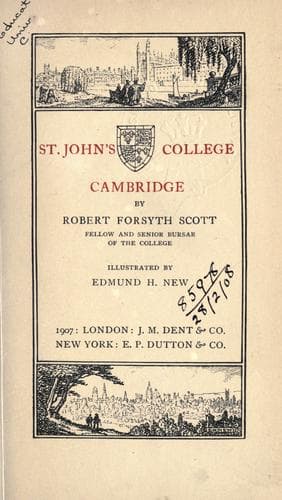
St. John's College, CambridgeScott, Robert Forsyth
History
St. John's College, Cambridge
Scott, Robert Forsyth
St. John's College (University of Cambridge) -- History
The institution of the Combination Room seems gradually to have grown up
in colleges as a place where the Fellows might meet together, partly
about business, partly for the sake of society. In early times, as the
Fellows shared their chambers with their pupils, there could have been
no privacy. The room seems to have been called the Parlour for some
time; the name Combination Room is now universal at Cambridge, and may
have arisen from the fact that the cost of running the room was met by
the Fellows combining together for the purpose. At the present time the
Combination Room is used for College meetings, as a room where the
Fellows meet for a short time after dinner and for dessert on those
nights when there is a dinner in Hall to which guests are invited.
_The Library._
The Library is only open to visitors by leave of the Librarian, or to
those accompanied by a Fellow of the College. The usual access is by
staircase E in the Second Court, but leaving the Combination Room by the
west door we find ourselves in front of the Library door. The visitor
may note that the moulded ceiling of the Combination Room extends
overhead. This portion, as we have already seen, originally forming part
of the long gallery.
The door of the Library is surmounted by the arms of John Williams,
impaled with those of the see of Lincoln. The original position of the
Library, as has been already stated, was in the First Court, next the
street, and to the south of the entrance gate. In 1616 the books were
moved out of this Library to a room over the Kitchen, and in the
succeeding year the Master and Fellows wrote to the Countess of
Shrewsbury to intimate their intention of building a Library, and
hinting at the possibility of her aid in the scheme. The answer of the
Countess, if there was one, has not been preserved. In the year 1623,
Valentine Carey, Bishop of Exeter, and a former Fellow, wrote announcing
that an unnamed person had promised L1200 towards a Library. After some
little time Lord Keeper Williams disclosed himself as the donor, and
some further advances were promised. The Library was commenced in 1623,
and the books finally placed in it in 1628. The style of the building is
Jacobean Gothic, and its interior, with the whitewashed walls and dark
oak roof and bookcases, is singularly striking. John Evelyn visited it
while at Cambridge in 1654, and describes it as "the fairest of that
University"; after 250 years the description still holds good.
The upper part of the Library has been little altered since it was
built. The intermediate (or lower) cases were heightened to the extent
of one shelf for folios when Thomas Baker left his books to the College;
but two, one on either hand next the door, retain their original
dimensions, with the sloping tops to be used as reading-desks.
Public-domain text, read in full here on John Shaqi.
Reviews
Reviews
No reviews yet
Be the first to share your thoughts on this work.
Join the Discussion
Join the discussion
Sign in to leave a comment or review.
Sign InorCreate an account