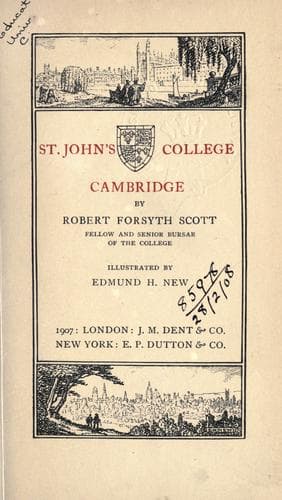
St. John's College, CambridgeScott, Robert Forsyth
History
St. John's College, Cambridge
Scott, Robert Forsyth
St. John's College (University of Cambridge) -- History
This last entry gives us the key to the troubles at St. John's; the
Marian exiles had returned with strong Calvinistic leanings. The unrest
was, of course, not confined to St. John's, but was general throughout
the University. But for the greater part of the reign of Elizabeth there
was a strong leaning toward Puritanism in the College. There was a rapid
succession of Masters, most of whom were thrust on the College by Court
influence; and about this time the Fellows of St. John's acquired the
reputation of being "cunning practitioners" in the art of getting rid of
unpopular Masters.
Queen Elizabeth visited Cambridge in August 1564, and was received with
all honour. She rode into the Hall of St. John's on her palfrey and
listened to a speech from Mr. Humphrey Bohun, one of the Fellows, in
which for the last time the restitution of the Lady Margaret's estates
was hinted at, without result.
Richard Longworth, a man of Presbyterian sympathies, was at this time
Master. In 1565 he, with the Fellows and scholars, appeared in Chapel
without the surplice. Lord Burghley, as Chancellor of the University,
wrote a sharply worded letter to Longworth, expressing his grief that
such a thing should happen in "my dear College of St. John's"; adding,
"truly no mishap in all my service did ever plunge me more grievously."
Fortunately affairs were in strong and capable hands. With the authority
and in the name of Queen Elizabeth, Whitgift, at this time Master of
Trinity, afterwards Archbishop of Canterbury, and Cecil provided new
statutes for the University in 1570, and for St. John's in 1580. By
these much more power was put in the hands of the Master, and government
rendered easier to a resolute man.
Matters improved, if not at once, at least gradually, and the Anglican
rule became firmly established. But during the mastership of William
Whitaker (1586-1595) we still hear of troubles with "Papists." Whitaker
was a learned scholar and an acute theologian, but he does not seem to
have been a ruler of men or a judge of character. He got involved in an
unfortunate dispute with Everard Digby, one of the Fellows, a man of
considerable literary reputation, but of a turbulent disposition.
Whitaker, who clearly wanted to get rid of Digby, seized upon the
pretext that his bill for a month's commons, amounting to 8s. 7-1/4d., was
left unpaid, and deprived Digby of his fellowship. An appeal was lodged
with Whitgift and Cecil, who ordered Whitaker to reinstate Digby.
Whitaker replied that Digby was a Papist, was wont to blow a horn in the
Courts and to holloa after it, and that he had threatened to put the
President in the stocks! He seems to have succeeded in getting rid of
Digby for good.
Public-domain text, read in full here on John Shaqi.
Reviews
Reviews
No reviews yet
Be the first to share your thoughts on this work.
Join the Discussion
Join the discussion
Sign in to leave a comment or review.
Sign InorCreate an account