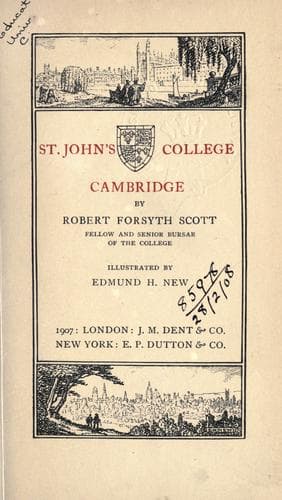
St. John's College, CambridgeScott, Robert Forsyth
History
St. John's College, Cambridge
Scott, Robert Forsyth
St. John's College (University of Cambridge) -- History
Amongst others who have held the Linacre lectureship, and attained to
scientific distinction, was Henry Briggs, who was appointed lecturer in
1592. He afterwards became Gresham Professor of Geometry and Savilian
Professor at Oxford. He took up Napier's discovery of logarithms; the
idea of tables of logarithms having 10 for their base, and the
calculation of the first table of the kind, is due to him.
CHAPTER V
THE SECOND CENTURY
1612-1716
The second century of the College history opened quietly. Owen Gwyn was
elected Master by the choice of the Fellows; John Williams, then a
Fellow, afterwards Lord Keeper, Dean of Westminster, Bishop of Lincoln,
and Archbishop of York, exerting himself on Gwyn's behalf. It appears
that Williams in after years repented of the choice, and Thomas Baker,
the historian of the College, speaks slightingly of Gwyn. Still, under
his rule the College flourished, and Williams himself marked the period
by providing the greater part of the funds for the new Library.
King James I. and Prince Charles (afterwards Charles I.) frequently
visited the University; James holding his Court at Trinity, but being
entertained at St. John's. On one of these occasions, comparing the
great Court of Trinity with the two then existing Courts of St. John's,
he is said to have remarked that there was no greater difference between
the two Societies than between a shilling and two sixpences.
[Illustration: _HALL, AND CHAPEL TOWER_]
With the advent of the Stuart kings the practice arose of sending
mandatory letters to Colleges, directing the election of named persons
to fellowships. In theory it may have been correct enough; the statutes
as enacted by Queen Elizabeth reserved to herself and her successors the
power of rescinding or altering them. To direct that the statutory
provisions as to elections should be dispensed with in favour of an
individual was thus within the sovereign's power, however inconvenient
it might prove in practice. One of the special grievances at St. John's
was that King James directed the College to elect a Scotchman, George
Seaton, M.A., to a fellowship, though there was none then actually
vacant. The College obeyed, informing his Majesty that they had made
their statutes wink to fulfil his bidding, and maintained an extra
Fellow for a time. The practice was, however, followed by others; and
Gwyn seems to have been deluged with letters from persons in high
places, begging for his favour at elections. At some Colleges the device
of "pre-elections" seems to have been resorted to; a promising man being
elected to the next fellowship which should be vacant. Thus, when the
vacancy became known, the College could, with a clear conscience, say
that it had been already filled up; there is, however, no trace of this
practice at St. John's.
Public-domain text, read in full here on John Shaqi.
Reviews
Reviews
No reviews yet
Be the first to share your thoughts on this work.
Join the Discussion
Join the discussion
Sign in to leave a comment or review.
Sign InorCreate an account