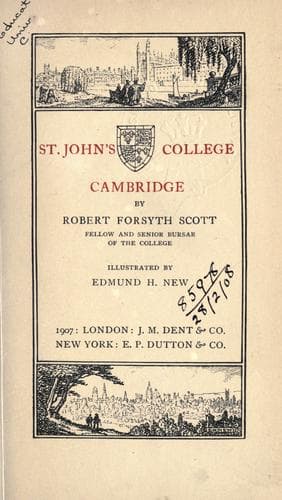
St. John's College, CambridgeScott, Robert Forsyth
History
St. John's College, Cambridge
Scott, Robert Forsyth
St. John's College (University of Cambridge) -- History
Just before this general register commenced, three notable men joined
the College: Thomas Wentworth, afterwards Earl of Strafford; Thomas
Fairfax, afterwards Lord Fairfax, the victor at Naseby; and Lucius Cary,
Viscount Falkland, who fell in Newbury fight in September 1643.
Complimentary letters to the first and last of these, with the replies,
have been preserved. Falkland, in his reply, complains that of the
titles given to him by the College "that which I shold most willingly
have acknowledged and mought with most justice clayme you were not
pleased to vouchsafe me, that of a St. John's man."
Of others who entered we may name: Sir Ingram Hopton, son of Ralph,
first Baron Hopton, who entered as a Fellow Commoner 12th May 1631. Sir
Ingram fell at the battle of Winceby, 11th October 1643. He there
unhorsed Oliver Cromwell in a charge, and knocked him down again as he
rose, but was himself killed.
Titus Oates, "the infamous," first entered at Caius 29th June 1667,
migrating to St. John's, where he entered 2nd February 1668-69. Thomas
Baker for once abandons his decorous reticence and states of Oates: "He
was a lyar from the beginning, he stole and cheated his taylor of a
gown, which he denied with horrid imprecations, and afterwards at a
communion, being admonisht and advised by his Tutor, confest the fact."
Matthew Prior, the poet, was both scholar and Fellow of the College,
holding his fellowship until his death. Robert Herrick, though he
graduated at Trinity Hall, was sometime a Fellow Commoner here. Thomas
Forster of Adderstone, general to the "Old Pretender," and commander of
the Jacobite army in 1715, entered the College as a Fellow Commoner 3rd
July 1700. Brook Taylor, well known to mathematicians as the discoverer
of "Taylor's theorem," entered as a Fellow Commoner 3rd April 1701.
While David Mossom of Greenwich, who entered the College as a sizar 5th
June 1705, after being ordained, emigrated to America, and became
rector of St. Peter's Church, New Kent County, Virginia. He was the
officiating clergyman at the marriage of George Washington in St.
Peter's Church.
Public-domain text, read in full here on John Shaqi.
Reviews
Reviews
No reviews yet
Be the first to share your thoughts on this work.
Join the Discussion
Join the discussion
Sign in to leave a comment or review.
Sign InorCreate an account