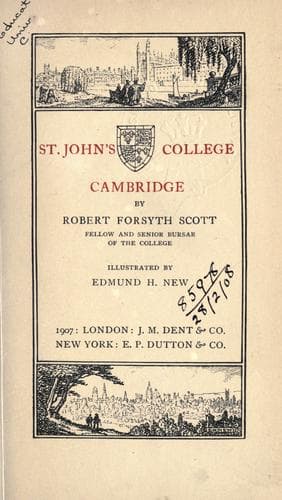
St. John's College, CambridgeScott, Robert Forsyth
History
St. John's College, Cambridge
Scott, Robert Forsyth
St. John's College (University of Cambridge) -- History
The statutes prescribed the appointment of certain lecturers--even the
subjects of their lectures. Space need not be occupied in showing that
such provisions soon became obsolete. The working solution was found in
the tutorial system. In early days it was contemplated and prescribed
that each Fellow should have the care of two or three students, living
with them, teaching them daily; the exact date when this system passed
away has not been traced with any certainty, but gradually the number of
Fellows taking individual charge of the undergraduates diminished until
it became reduced to two or three. Those in charge became known as
Tutors, and with each Tutor was associated one or two others called
Assistant Tutors or Lecturers. A charge was made to the undergraduates
for tuition, and the sum so received was shared by the Tutors and their
assistants. But the Tutor was not a College officer in the eye of the
statutes, nor the money received for tuition treated as part of the
College revenues. The system worked, because it was meant to work, and
as it was not subject to obsolete rules could be modified and adapted to
changing conditions. So long as the chief subjects of study were few in
number, practically restricted to classics and mathematics, College
provision for teaching was possible and simple. The multiplication of
studies, the needs of the studies generally known as the Natural
Sciences, with their expensive laboratories and equipment, are entailing
further changes, and the tendency, more especially in the newer
subjects, is to centralise teaching under the control of University
professors and teachers. The subject is one of great interest, but
cannot be further touched upon here. To return to the history of St.
John's.
Dr. James Wood became Master in 1815. He was a man of humble origin, a
native of Holcombe, in the parish of Bury, Lancashire. According to a
well-authenticated tradition he "kept," as an undergraduate, in a garret
in staircase O in the Second Court, and studied in the evening by the
light of the rush candle which lit the staircase, with his feet in
straw, not being able to afford fire or light. He became a successful
and popular College Tutor, and his mathematical writings were long the
standard text-books in the University. At the time of his death in 1839
he held, with his mastership, the Deanery of Ely and the Rectory of
Freshwater in the Isle of Wight. He made the College his residuary
legatee, but during his life had handed over large sums for College
purposes, and the total of his gifts cannot have been less than L60,000.
In Wood's time we find the first movement in favour of change taken by
the College itself. St. John's then suffered under a specially awkward
restriction arising from the joint effect of the general statutes and
the trusts of private foundations. By the statutes not more than two
Fellows could come from any one county in England, or more than one from
each diocese in Wales.
Public-domain text, read in full here on John Shaqi.
Reviews
Reviews
No reviews yet
Be the first to share your thoughts on this work.
Join the Discussion
Join the discussion
Sign in to leave a comment or review.
Sign InorCreate an account