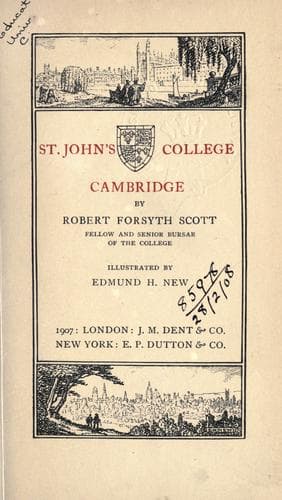
St. John's College, CambridgeScott, Robert Forsyth
History
St. John's College, Cambridge
Scott, Robert Forsyth
St. John's College (University of Cambridge) -- History
The original, and perhaps the chief, purpose of the College in the eyes
of those who founded it was practically that it should form a training
ground for the clergy. The statutes of King Henry VIII. distinctly lay
down that theology is the goal to which philosophy and all other studies
lead, and that none were to be elected Fellows who did not propose to
study theology. The statutes of Elizabeth provided a certain elasticity
by prescribing that those Fellows who did not enter priests' orders
within six years should vacate their fellowships; but that two Fellows
might be allowed, by the Master and a majority of the Senior Fellows, to
devote themselves to the study of medicine. King Charles I. in 1635
allowed a like privilege to be granted from thenceforth to two Fellows
who were to study law. These privileges were not always popular, and we
occasionally find the clerical Fellows complaining that while the
duties of teaching and catechising were laid on them, a man who had held
one of the law or medical fellowships sometimes took orders late in life
and then claimed presentation to a College benefice in virtue of his
seniority as a Fellow, having in the meantime escaped the drudgery to
which the Fellow in orders had been subject.
The emoluments of members of the Society in early times were very
modest, and as prices rose became quite inadequate; the amounts being
named in the College statutes were incapable of alteration, and indirect
means were taken to provide relief. In Bishop Fisher's time it was
considered that an endowment of L6 a year sufficed to found a
fellowship, and L3 a year to found a scholarship. The statutable stipend
of the Master was only L12 a year, though he had some other allowances,
the total amount of which was equally trivial. James Pilkington, Master
from 1559 to 1561, when he became Bishop of Durham, wrote to Lord
Burghley on the subject of his successor, stating that whoever became
Master must have some benefice besides to enable him to live. Richard
Longworth, Master from 1564 to 1569, made a similar complaint, putting
the weekly expenses of his office at L3. We accordingly find that many
of the Masters held country benefices, prebends, or deaneries with their
College office. Lord Keeper Williams, who gave to the College the
advowsons of Soulderne in Oxfordshire, Freshwater in the Isle of Wight,
and the sinecure rectories of St. Florence and Aberdaron in Wales, made
it part of the conditions of his gift that the Master should always be
entitled to take one of these livings if a vacancy occurred. Many of the
Fellows also held benefices or curacies near Cambridge. In the
eighteenth century the business of holding ecclesiastical preferment in
plurality became almost a fine art; thus Sir Isaac Pennington, who was
President of the College and Regius Professor of Physic, left to the
College by his will a fund to provide the sum of L200 a year for the
Master "if he be rector of Freshwater and not otherwise," a direct and
Public-domain text, read in full here on John Shaqi.
Reviews
Reviews
No reviews yet
Be the first to share your thoughts on this work.
Join the Discussion
Join the discussion
Sign in to leave a comment or review.
Sign InorCreate an account