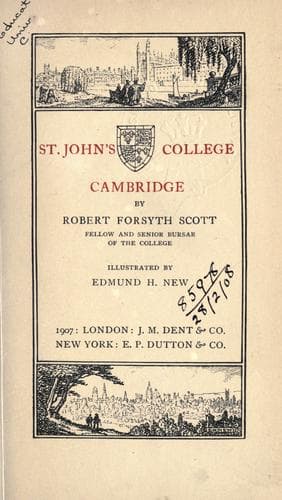
St. John's College, CambridgeScott, Robert Forsyth
History
St. John's College, Cambridge
Scott, Robert Forsyth
St. John's College (University of Cambridge) -- History
Students from distant parts of England probably resided continuously in
College from the time they entered it until they took their degrees. The
statutes of King Henry VIII. contemplate a period of some relaxation at
Christmas; providing that each Fellow in turn should be "Lord" at
Christmas, and prepare dialogues and plays to be acted by members of the
College between Epiphany and Lent. The brazier in the Hall seems to have
been kept burning in the evening about Christmas time; of this practice
a curious relic survived until comparatively lately, it being the custom
to leave a few gas-jets burning in the Hall until midnight from St.
John's Day (December 27) until Twelfth Night.
There were three classes of students. The Fellow Commoners, sons of
noblemen or wealthy land-owners, who sat at the High Table, or, as it
was phrased, were in Fellows' commons. Some came in considerable state.
In 1624 the Earl of Arundel and Surrey sent his two sons, Lord
Maltravers and Mr. William Howard, to the College. The Earl's chaplain,
or secretary, in making arrangements for their coming, wrote to request
that they should have one chamber in the College, with a "pallett for
the gromes of their chamber"; the rest of "his lordships company, being
two gentlemen, a grome of his stable and a footman, may be lodged in the
towne near the College." At this period the Second Court had been built,
and the accommodation for residence thus somewhat greater than in
Elizabethan times. The Fellow Commoner wore a gown ornamented with gold
lace, and a cap with a gold tassel. The last Fellow Commoner at St.
John's to wear this dress was the present Admiral Sir Wilmot Hawksworth
Fawkes.
The next class in order of status were the Pensioners--men who paid
their expenses without assistance from the College, sons of middle-class
parents. In times of which we have any definite record this was the most
numerous class in College. Lastly, we have the sizars. A sizar was
definitely attached to a Fellow or Fellow Commoner; he was not exactly a
servant, but made himself generally useful. For example, those members
of the College who absented themselves from the University sermon were
in the eighteenth century fined sixpence, and the sizars were expected
to mark the absentees. The sizar at Cambridge had, however, always a
better status than the servitor at Oxford, and in the days when
scholarships were strictly limited as to locality, a sizarship was
something of the nature of what at the present day we should describe as
an entrance scholarship or exhibition, the assistance given consisting
in a reduction of expenses rather than in actual direct emolument. At
the present time there is no difference in status among members of the
College; the foundation scholars, however, having special seats in
Chapel and a separate table in Hall if they choose to make use of it.
Public-domain text, read in full here on John Shaqi.
Reviews
Reviews
No reviews yet
Be the first to share your thoughts on this work.
Join the Discussion
Join the discussion
Sign in to leave a comment or review.
Sign InorCreate an account