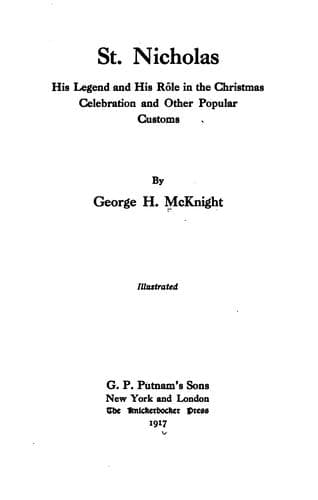
St. Nicholas: His Legend and His Rôle in the Christmas Celebration and Other Popular CustomsMcKnight, George Harley
History
St. Nicholas: His Legend and His Rôle in the Christmas Celebration and Other Popular Customs
McKnight, George Harley
Christmas; Nicholas, Saint, Bishop of Myra
In all north Germany, too, on Christmas eve, there goes about a bearded
man covered with a great hide or with straw, who questions children
and rewards their good conduct. His name varies with the locality.
In many places he is called “Knecht Ruprecht,” a name probably going
back to a pre-Christian time before St. Nicholas became associated
with the children’s festival. In other places the man is called “De
Hele Christ,” Holy Christ, who later becomes the central figure of all
Christmas activities. In many of his names, however, such as “Rû Clås,”
“Joseph Clås,” “Clåwes,”[24] “Clås Bůr,” and “Bullerclås,” one will
recognize the juvenile derivative from the name Nicholas. This figure
often rides on a white horse. Not infrequently his relation to the
Christmas festival proper needs to be made clear by the presence of the
Holy Christ as a companion, represented by a maiden in white garb who
hears the children say their prayers.
Saint Nicholas in the double rôle of children’s benefactor and
children’s bugaboo found his way to America. Among the Pennsylvania
Germans, or “Pennsylvania Dutch,” as they are more familiarly called,
at least in the country districts, he continues to play his old part.
“You’d better look out or Pelznickel will catch you,” is the threat
held out over naughty children about Christmas time. The nickel in
Pelznickel serves to show the relationship of this personage to
St. Nicholas. Pelznickel is a Santa Claus with some variations. “On
Christmas eve someone in the neighborhood impersonates Pelznickel by
dressing up as an old man with a long white beard. Arming himself with
a switch and carrying a bag of toys over his shoulder, he goes from
house to house, where the children are expecting him.
“He asks the parents how the little ones have behaved themselves during
the year. To each of those who have been good, he gives a present from
his bag. But woe betide the naughty ones! These are not only supposed
to get no presents, but Pelznickel catches them by the collar and
playfully taps them with his switch.”[25]
Eventually, in many places, St. Nicholas became quite excluded from the
customs with which he was long associated. In Schleswig-Holstein, for
instance, at the beginning of the nineteenth century, the old customs
were preserved but entirely separated from their earlier associations
with St. Nicholas and St. Nicholas’ eve, and now connected with the
story of the Christ Child and His festival, Christmas. The custom was
for each child to borrow a plate or bowl from the kitchen and place
this in an appointed room or in a window. On Christmas eve, when the
tinkle of the bell summoned the children from the dark anteroom
into the room with the festal decorations, then each child found what
the Christ Child (“Kindjes”) had brought him. On the plates lay cakes,
fruits, and playthings. Perhaps a rod was laid beside the other gifts,
but it counted as the most severe punishment when the plate remained
empty.
Public-domain text, read in full here on John Shaqi.
Reviews
Reviews
No reviews yet
Be the first to share your thoughts on this work.
Join the Discussion
Join the discussion
Sign in to leave a comment or review.
Sign InorCreate an account