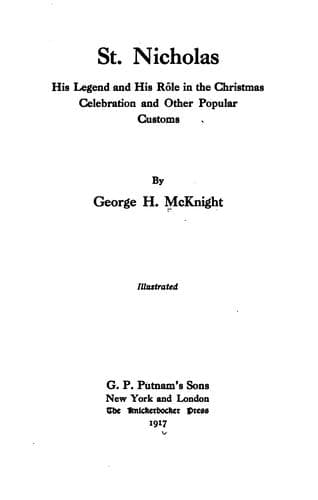
St. Nicholas: His Legend and His Rôle in the Christmas Celebration and Other Popular Customs — John Shaqi
St. Nicholas: His Legend and His Rôle in the Christmas Celebration and Other Popular CustomsMcKnight, George Harley
History
St. Nicholas: His Legend and His Rôle in the Christmas Celebration and Other Popular Customs
McKnight, George Harley
Christmas; Nicholas, Saint, Bishop of Myra
In all this discussion of various customs associated with the name
of St. Nicholas there will have been seen little to connect with the
life story of a saintly person. The deeds of the children’s friend,
St. Nicholas, to be sure exhibit beneficence, but the beneficence of
a capricious, fairy-like benefactor rather than of a holy saint. In
fact it is evident that the customs in question, in their origin,
had little, if anything to do with St. Nicholas, and as they exist
to-day show only in certain external features any relation with the
life story of the kindly Eastern saint. This impression of the earlier
independence of the popular customs in question from the story of St.
Nicholas, is confirmed by the fact that many of them are associated
with other names. St. Martin, as well as St. Nicholas, figures as a
giver of gifts to children, especially in the Netherlands. At Antwerp
and certain other cities, according to a report from a generation ago,
on St. Martin’s day, as in the St. Nicholas’ day celebration already
described, a man with bishop’s vestments and crosier appeared in the
nurseries and made inquiries about the behavior of the children.
According to the nature of this report he threw on the floor from his
basket, either rods, or apples, nuts, and cakes. In Ypres children are
reported to hang stockings filled with hay in the open chimneypiece on
the eve of Martinmas. The next morning the stockings are found filled
with gifts from St. Martin who in the night has ridden over the chimney
and has been grateful for the attention paid to his gray (or white)
steed.[28] There is also an old custom in Flemish Belgium in which on
the eve of Martinmas the children are placed in the corner of a room
with their backs to the door and told not to look. The parents then
throw in at the door apples, nuts, peppercakes, and other sweetmeats of
various kinds, pretending that St. Martin has done it. If one of the
children turns around, St. Martin goes away without leaving anything.
The bugaboo feature of St. Nicholas’ day also was not lacking in the
Martinmas celebration. In several places in southern Germany, on St.
Martin’s day, “Pelzmärte,” with blackened face and cowbells, went about
giving beatings or throwing apples into rooms, whichever the children’s
behavior called for.
Some of the Martinmas customs had less resemblance to St. Nicholas
customs. The convivial customs of Martinmas have given St. Martin a
reputation for drunkenness entirely undeserved by that zealous defender
of Christianity, St. Martin of Tours. But the ones singled out for
mention evidently belong jointly to St. Martin and St. Nicholas,
although in their origin probably as little connected with the one as
with the other.
Public-domain text, read in full here on John Shaqi.
Reviews
Reviews
No reviews yet
Be the first to share your thoughts on this work.
Join the Discussion
Join the discussion
Sign in to leave a comment or review.
Sign InorCreate an account