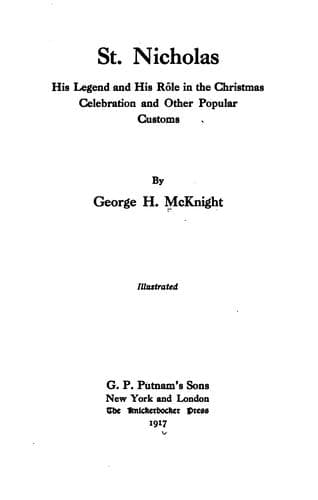
St. Nicholas: His Legend and His Rôle in the Christmas Celebration and Other Popular Customs — John Shaqi
St. Nicholas: His Legend and His Rôle in the Christmas Celebration and Other Popular CustomsMcKnight, George Harley
History
St. Nicholas: His Legend and His Rôle in the Christmas Celebration and Other Popular Customs
McKnight, George Harley
Christmas; Nicholas, Saint, Bishop of Myra
St. Nicholas was likewise venerated as the protector of virgins;
there are, or were until lately, numerous fantastical customs
observed in Italy and various parts of France, in reference to that
peculiar tutelary personage. In several convents it was customary,
on the eve of St. Nicholas for the boarders (_sic_) to place each
a silk stocking at the door of the apartment of the abbess with
a piece of paper enclosed, recommending themselves to “great
St. Nicholas of her chamber,” and the next day they were called
together to witness the saint’s attention, who never failed to fill
the stockings with sweetmeats and other trifles of that kind, with
which these credulous virgins made a general feast.
If the kindly saint, in this case, was not in position to provide
husbands, he at least provided agreeable consolation.
The conception of St. Nicholas as the protector of maidens and the
provider of husbands and the association of this idea with the story
of his generous act toward the three maidens in distress, is by no
means extinct in our own times, as is shown by the following account of
English customs recorded in a recent newspaper:[49]
In the mining districts of the North of England they still
maintain the pleasant custom of collecting “maidens’ purses” on
Christmas eve.
These purses, in most cases subscribed for by the mining folk
themselves, are intended as marriage portions for girls undowered
with worldly wealth, who are expecting to be led to the altar. On
Christmas eve the full purse is stealthily thrown in at the girl’s
window to avoid any possibility of wounding her feelings.
In one parish four purses are provided every Christmas eve by
a woman now rich, who makes no secret of the fact that her own
wedding day was brightened by the gift thrown in at the window when
she was a miner’s lass.
[Illustration: L. di Bicci. Madonna and Child and Various Saints with
their Conventional Emblems.
Alinari]
Among the images of saints in France and other northern countries of
Europe, as has already been remarked, the tub with the three saved
youths is the conventional sign of St. Nicholas. Italian artists,
on the other hand, represent St. Nicholas in bishop’s garb and with
three golden balls, commonly on a book which he holds in his hand,
but sometimes in his cap or at his feet.[50] This conventional symbol
of the three balls is sometimes explained as alluding to the Trinity,
or to the loaves of bread used by the saint in feeding the poor in a
famine, but is more usually associated with the three gifts to the
three maidens, the balls of gold corresponding in appearance to the
handfuls of gold tied up in a handkerchief thrown in at the window by
St. Nicholas, in the representations of the scene.
Public-domain text, read in full here on John Shaqi.
Reviews
Reviews
No reviews yet
Be the first to share your thoughts on this work.
Join the Discussion
Join the discussion
Sign in to leave a comment or review.
Sign InorCreate an account