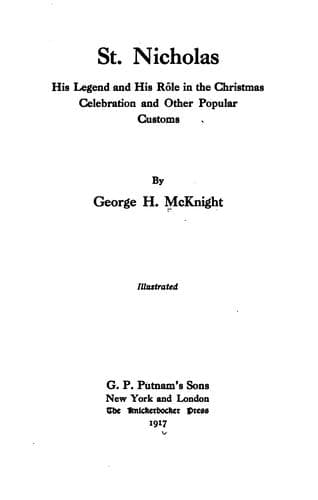
St. Nicholas: His Legend and His Rôle in the Christmas Celebration and Other Popular Customs — John Shaqi
St. Nicholas: His Legend and His Rôle in the Christmas Celebration and Other Popular CustomsMcKnight, George Harley
History
St. Nicholas: His Legend and His Rôle in the Christmas Celebration and Other Popular Customs
McKnight, George Harley
Christmas; Nicholas, Saint, Bishop of Myra
the expenses of the feast, with the exception of the dinner on
the day after Innocents’ day, which came out of the disciplinary
fines, are assigned by the statutes to the canons in the order of
their appointment. The responsible canon must give a supper on
Innocents’ day, and on the following day a dessert out of what
is over. He must also provide the “Bishop” with a horse, gloves,
and a _biretta_ when he rides abroad. At the supper a curious
ceremony took place. The canon returned thanks to the “Bishop,”
apologized for any shortcomings in the preparations, and finally
handed the “Bishop” a cap of rosemary or other flowers, which was
then conferred upon the canon to whose lot it would fall to provide
the feast for the next anniversary. Should the canon disregard
his duties the boys and sub-deacons were entitled to hang up a
black cope on a candlestick in the middle of the choir _in illius
vituperium_ for as long as they might choose.
The elaborateness, too, of the manner of celebration, as well as the
constant association with St. Nicholas, may be inferred from the
following Northumberland inventory of robes and ornaments belonging to
one of these Boy Bishops:[60]
Imprimis, i. myter, well garnished with perle and precious stones,
with nowches of silver and gilt before and behind. Item, iiii.
rynges of silver and gilt, with four ridde precious stones in them.
Item, i. pontifical with silver and gilt, with a blue stone in
hytt. Item, i. owche, broken, silver and gilt, with iiii. precious
stones, and a perle in the mydds. Item, a croose, with a staff of
coper and gilt, with the ymage of St. Nicolas in the mydds. Item,
i. vestment, redde, with lyons, with silver, with brydds of gold in
the orferes of the same. Item, i. albe to the same, with starres in
the paro. Item, i. white cope, stayned with tristells and orferes,
redde sylke, with does of gold, and whytt napkins about the necks.
Item, iiii. copes, blew sylk with red orferes, trayled, with whitt
braunchis and flowers. Item, i. steyned cloth of the ymage of St.
Nicholas. Item, i. taberd of skarlet, and a hodde thereto lyned
with whitt sylk. Item, a hode of skarlett, lyned with blue sylk.
The earliest known reference to the Boy Bishop custom is from St.
Gall in the year 911. King Conrad I. was visiting Bishop Solomon of
Constance and heard so much of the Vespers procession at St. Gall that
he determined to visit the monastery at the time of the revels. He
found it “all very amusing and especially the procession of children,
so grave and sedate that even when Conrad bade his train roll apples
along the aisle, they did not budge.”[61] In later years the custom
lost much of its early sobriety, although doubtless a great deal of
dignity, real or assumed, persisted in the church procession. The
custom pervaded most of the countries of Europe in the following
centuries.
Public-domain text, read in full here on John Shaqi.
Reviews
Reviews
No reviews yet
Be the first to share your thoughts on this work.
Join the Discussion
Join the discussion
Sign in to leave a comment or review.
Sign InorCreate an account