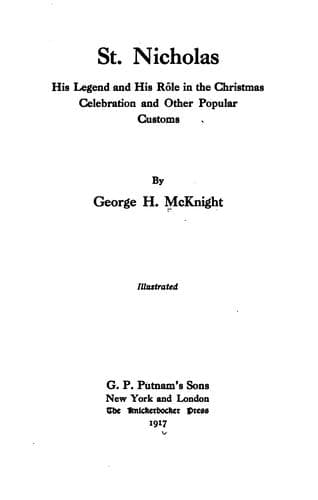
St. Nicholas: His Legend and His Rôle in the Christmas Celebration and Other Popular CustomsMcKnight, George Harley
History
St. Nicholas: His Legend and His Rôle in the Christmas Celebration and Other Popular Customs
McKnight, George Harley
Christmas; Nicholas, Saint, Bishop of Myra
“Another he dede sekyrly,
He saved a thief that was ful sly,
That stal a swyn out of his sty,
His lyf than savyd he.”
CHAPTER IX
PAGAN HERITAGE OF ST. NICHOLAS
It is well known that when paganism was superseded by Christianity, the
older religion was by no means obliterated. In Greece the pagan temples
often were converted into Christian churches. At Athens, the Parthenon,
a temple of the Virgin Pallas, became a church of the Virgin Mary; the
temple of Theseus became a church devoted to a Christian hero, also
a dragon-slayer, St. George of Cappadocia. In the structure of new
churches, material from the older temples was freely used. In many of
the churches of Rome may be seen beautiful classical columns taken
from the earlier pagan structures. A fine instance of the mingling of
elements, old and new, in Christian architecture, is to be seen at
Syracuse in Sicily, where the older classical temple of Minerva has
been transformed into a renaissance cathedral. The columns of the Doric
temple are built into the wall of the church but are too thick to be
concealed. On the outside they may be seen, at times a protruding Doric
capital, at times a whole Doric column; within the church, they form
a line of magnificent weathered columns bordering the outer side of
each aisle. In this church, to the Christian and pagan combination,
is superadded a third element, in the form of rounded Saracenic
battlements.
The hybrid nature of this Christian architecture in the countries
pervaded by classical civilization finds a striking parallel in the
Christian practices and Christian beliefs of these countries. In these,
too, there is evident a mingling of elements new and old, Christian
and pagan, with here and there a tinge taken on from later forms of
non-Christian religion, corresponding to the Saracenic element in the
architecture of the cathedral at Syracuse. Just as the graceful classic
columns survive as beautiful features in the Christian churches,
so, many fair products of the poetic imagination belonging to the
earlier faith have found a place in the Christian religion. This is
particularly true in the case of the saints, who continue to exert over
the forces of nature the same control in the interests of man that the
minor gods and demi-gods had done before.
Public-domain text, read in full here on John Shaqi.
Reviews
Reviews
No reviews yet
Be the first to share your thoughts on this work.
Elsewhere in the archive
Join the Discussion
Join the discussion
Sign in to leave a comment or review.
Sign InorCreate an account