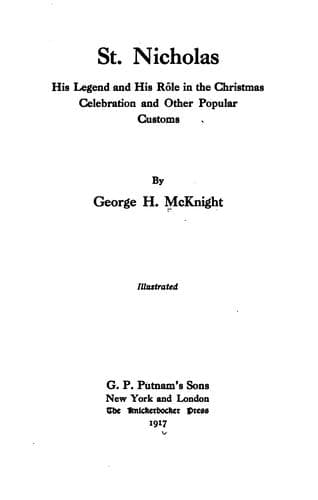
St. Nicholas: His Legend and His Rôle in the Christmas Celebration and Other Popular CustomsMcKnight, George Harley
History
St. Nicholas: His Legend and His Rôle in the Christmas Celebration and Other Popular Customs
McKnight, George Harley
Christmas; Nicholas, Saint, Bishop of Myra
Controversy, particularly religious controversy, has its pitfalls even
for those of most gentle nature, and connected with this momentous
occasion and the part in it played by St. Nicholas, there is a
legendary story[109] which exhibits a side to his character, if less
saintly, at least, more human. The story goes that St. Nicholas at Nice
struck an Arian bishop who spoke against the faith and that, for this
too violent zeal, he was deprived of the right of wearing bishop’s
robes. But, the story adds, in celebrating the mass, he saw angels
bearing him the miter and the pallium as a sign that Heaven had not
blamed his wrath.
The orthodoxy of St. Nicholas is thus put beyond question. If he was a
foe to heresy, he was still more a foe to paganism. In the story from
the Golden Legend already quoted is recorded his activity in uprooting
the worship of Diana in Lycia and the particular hatred of the goddess,
or devil as she was conceived of, that he incurred thereby. Concerning
his zeal in this work, Wace[110] has the following additional details
to offer. “Before the time of St. Nicholas,” he tells us, “devils had
power. People worshiped gods and goddesses: Phœbus, Jupiter, Mars,
Mercury, Diana, Juno, Venus, Minerva. They had painted images with
names written on the foreheads. Diana in particular was a she-devil.
St. Nicholas broke her image and delivered the people from idolatry.”
[Illustration: St. Nicholas Represented (Byzantine style) in the
Mosaics of St. Mark’s in Venice.
Naya]
But it is particularly in the conflict between Christianity and
Mohammedanism that St. Nicholas is prominent as defender of the faith.
The time when St. Nicholas worship was introduced in the West was a
time when this conflict was at its height, the time of the Crusades.
It will be remembered how Jean Bodel in his play, written about the
year 1200, made new use of the story of the image of St. Nicholas set
as the guardian of treasure. It will be remembered that the setting
for the story provided by Bodel was in the wars of Christian against
Saracen, and that the central feature of the story in the play is the
way in which the Christian image of St. Nicholas proved his power to
be greater than that of the Mohammedan idol of Tervagant, and thus led
the Mohammedan king with his seneschal and all his emirs to adopt the
Christian faith.
Public-domain text, read in full here on John Shaqi.
Reviews
Reviews
No reviews yet
Be the first to share your thoughts on this work.
Elsewhere in the archive
Join the Discussion
Join the discussion
Sign in to leave a comment or review.
Sign InorCreate an account