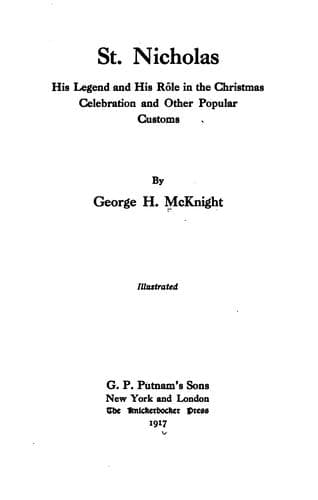
St. Nicholas: His Legend and His Rôle in the Christmas Celebration and Other Popular CustomsMcKnight, George Harley
History
St. Nicholas: His Legend and His Rôle in the Christmas Celebration and Other Popular Customs
McKnight, George Harley
Christmas; Nicholas, Saint, Bishop of Myra
In Eastern countries the conflict between Christianity and
Mohammedanism, so much alive in Western Europe in the time of the
Crusades, continues in active form in our own time. It must be
remembered, too, that in Eastern countries St. Nicholas occupies a
place even higher than that occupied by him in the West in our time.
It is not unnatural, then, that there he should be looked to as the
defender of the Christian faith. How well he is thought to be able to
represent the Christian cause is well brought out in a naïvely humorous
Albanian folk-tale.[111] The story goes as follows: Mohammed was the
guest of St. Nicholas. When the time to eat came around, Mohammed asked
where were the servants. St. Nicholas replied that no servants were
needed, that at a word from his mouth or a stroke on the table, the
edibles would be ready. He then proceeded to demonstrate that what he
said was entirely true, causing to appear on the table everything that
one could desire to eat and drink.
Mohammed, not to be outdone, on his return home caused his servant to
construct a table which would turn and could thus be closed into the
wall leaving no visible sign. He commanded his servant to make ready
food of every kind, and when he heard a rap, to push the laden table
through the wall. He then invited St. Nicholas to his house, intending
to exhibit powers as great as those shown by St. Nicholas.
But St. Nicholas made all his plans go awry. He made the servant deaf,
so that there was no response to the rap of Mohammed, and St. Nicholas
himself had to get up and bring in through the wall the table laden
with food, naturally to the discomfiture of his host.
The next day Mohammed invited St. Nicholas again, promising to work
a miracle before him. He caused a great number of jugs and cans and
dishes of various kinds to be taken to the top of a hill. At a sign
from Mohammed, these were to be rolled down the hill and a cannon
fired. When St. Nicholas arrived, he bade Mohammed work his miracle.
Mohammed raised his hand, and the expected noise followed. St.
Nicholas, however, gave no sign of fear. Mohammed then bade him work a
miracle. St. Nicholas clapped his hands, and immediately the thunder
rolled and the lightning flashed, overwhelming Mohammed with terror.
CHAPTER XI
CONCLUSION
And when it pleased our Lord to have him depart out of this world,
he prayed our Lord that he would send him his angels, and inclining
his head, he saw the angels come to him, whereby he knew well
that he should depart, and began this holy psalm: _In te domine
speravi_, unto _in manus tuas_, and so saying: “Lord into thine
hands I commend my spirit,” he rendered up his soul and died, the
year of our Lord three hundred and forty-three, with great melody
sung of the celestial company.
Public-domain text, read in full here on John Shaqi.
Reviews
Reviews
No reviews yet
Be the first to share your thoughts on this work.
Elsewhere in the archive
Join the Discussion
Join the discussion
Sign in to leave a comment or review.
Sign InorCreate an account