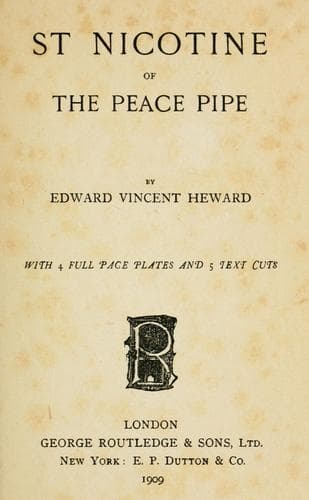
St Nicotine of the Peace PipeHeward, Edward Vincent
History
St Nicotine of the Peace Pipe
Heward, Edward Vincent
Smoking; Tobacco
It is noteworthy that even tobacco-leaves, the avowed destroyers of
insect life, should themselves be the prey of some form of the ubiquitous
microbe. Besides the mite just mentioned that speckles the outer leaf
of old cigars, a more ravenous one has been discovered working its will
on Indian cigar-leaf. In a recent issue of _Indian Museum Notes_, Mr.
Cote gives an interesting account of the works and ways of an insect
that drills tiny round holes in tobacco-leaves, so small indeed that
they had escaped observation until the havoc wrought awakened alarm.
The pest tunnels its way through the leaf, irrespective of strength or
flavour, even the Trichinopoli is not beyond its taste. And it multiplies
so rapidly that much valuable leaf is soon rendered worthless for
smoking. Its method of working has suggested the name of weevil. The
Indian tobacco industry, therefore, has now to reckon with a new and
unscrupulous competitor in the form of the ‘cigar weevil.’ It would be a
boon to long-suffering humanity and a triumph for the bacteriologist if
he could manage to set one tribe against another of these evil-doers, to
their mutual destruction. If they are like living things in the natural
world they will have their foes and their struggles for existence. The
old lady’s belief that microbes have pink eyes and ravenous teeth may
not be perfectly accurate, yet judging from their insidious attacks on
unsuspecting mortals we are warranted in assuming that they have other
very effective means of combat. The spectacle of internecine warfare
going on in their little world, as revealed under the microscope, would
afford from its novelty an exhibition worth going miles to see.
The tobacco-plant is not now cultivated in England. James the First
thought it shameful that so pernicious a plant should be permitted to
take root in our rich and fruitful soil, and caused an edict to be issued
prohibiting its cultivation within the British Islands. The King’s
apologists find reason for the prohibition in his Majesty’s concern
for the interests of the young colony of tobacco planters settled in
Virginia. Be this as it may, Adam Smith (Wealth of Nations) on economic
grounds condemns the enactment, saying, ‘Home cultivation of tobacco has
on this account most absurdly been prohibited through the greater part
of Europe which necessarily gives a monopoly to the countries where its
cultivation is allowed.’
Public-domain text, read in full here on John Shaqi.
Reviews
Reviews
No reviews yet
Be the first to share your thoughts on this work.
Elsewhere in the archive
Join the Discussion
Join the discussion
Sign in to leave a comment or review.
Sign InorCreate an account