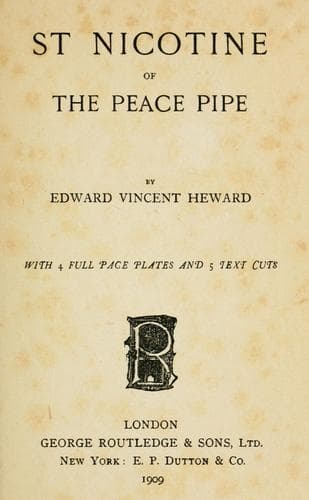
St Nicotine of the Peace PipeHeward, Edward Vincent
History
St Nicotine of the Peace Pipe
Heward, Edward Vincent
Smoking; Tobacco
To the impoverished treasury of Charles the Second its importation was
made to yield revenue at a rate equivalent to about thirty shillings
a pound weight of our present money, and through the agency of his
ministers enacted in ‘Laws and Regulations concerning Tobacco’ (15 Car.
II. c. 7. 12. Par. II. c. 34.) that, ‘Tobacco is not to be planted in
England on a forfeiture of 40s. for every rood of ground thus planted.’
This restriction however was ‘not to extend to the planting of tobacco
in Physic Gardens, in quantities not exceeding half a pole, and also,
on forfeiture of £10 for every rood of ground.’ These prohibitory
measures remained in force until April 1886, when English farming being
in _in extremis_ the Government granted permission to grow the plant
in the United Kingdom, under certain precautions and restrictions for
the purpose of safe-guarding the revenue. Several land-owners in Kent,
Norfolk and Essex, tried their prentice hand in the new husbandry,
notably, Messrs. James Carter & Company of Bromley, whose first
crop seemed to give fair promise of future success. Their sanguine
expectations however were short-lived. What with hampering restrictions
on the one hand and our fickle climate on the other, it soon became too
apparent that English agriculturists must not look to the Indian weed for
the much needed succour. The crops raised proved to be unmarketable. The
cultivation of the tobacco-plant in these islands is no longer authorized.
The Home manufacture of cigars from foreign leaf however increased by
leaps and bounds, and now affords remunerative employment for many
thousands of work-people in London alone. There are also large tobacco
factories in the chief seats of industry and commerce throughout the
kingdom. This is due in great measure to the heavy tax levied upon
foreign made cigars imported into this country, namely, six shillings on
every pound weight—_i.e._, double the sum charged on tobacco in the leaf.
This great difference would seem to afford the unscrupulous an incentive
to fabricate spurious high-priced cigars under foreign names. Looked at
in this light it may be a question worth the consideration of the Board
of Customs whether or not it would be well to lessen the difference
between the two rates of duty—to raise the one and lower the other—with
advantage to both the consumer and the revenue.
Public-domain text, read in full here on John Shaqi.
Reviews
Reviews
No reviews yet
Be the first to share your thoughts on this work.
Elsewhere in the archive
Join the Discussion
Join the discussion
Sign in to leave a comment or review.
Sign InorCreate an account